
Not All Protein Is Equal: How to Read Food Labels for Real Protein
Understanding Food Labels for Optimum Protein Choices
You might have noticed a heightened interest in protein lately. The popularity of protein is soaring today, with a ton of new products hitting the shelves advertising the benefits of increased protein consumption. As a result, people are increasing their protein intake, leading to a booming market with new high-protein snacks and beverages appearing on shelves and menus. Data suggests that consumers have boosted their protein intake a whopping 61% in 2025.
This is understandable, as protein has many health benefits. Protein is the building block of muscle. It digests slowly, which improves satiety and aids in weight management. Protein also offers more general health benefits, such as supporting bone and skin health and regulating hormones. It is crucial for essential bodily functions, as the body needs amino acids from protein to build and repair cells, organs, and tissues.

But with this surge in protein advertising, how do we know when something is truly a good source of protein?
Nurtient Content Claims and Product Labeling
The best sources of protein include lean meats, poultry, and fish, along with eggs and dairy products like Greek yogurt and cottage cheese. Or for vegetarians: beans, lentils, nuts, seeds, and soybean products like tofu and edamame. But what about the host of prepackaged or processed foods that are advertised as good sources of protein? For example:
-
- Protein bars
- Protein powders
- Protein pancake mix
- Protein drinks and shakes
- Protein cereals
- Protein cookies or chips
- Protein yogurts
Advertisements of this sort are called nutrient content claims. Nutrient content claims imply health benefits by describing the level of nutrients in a product using terms like “high,” “low,” or compared to another product using terms like “more” or “reduced.” You are dealing with nutrient content claims whenever a cereal box says “good source of fiber” or the mayonnaise says it’s “low fat.” We are also dealing with nutrient content claims when a product is advertised as “high protein” or “good source of protein.” But are these claims grounded in fact?
Nutrient content claims are regulated by the Food and Drug Administration. According to the FDA, something is a “good source of protein” if it contains 10-19% of the recommended daily value for protein. It is “high protein” if it is 20% or higher. The daily value (DV) can be found on food labels. For example, below is a label from the People’s Choice brand of beef jerky. The protein line tells you how many grams of protein per serving, and gives you the DV per serving beside it:
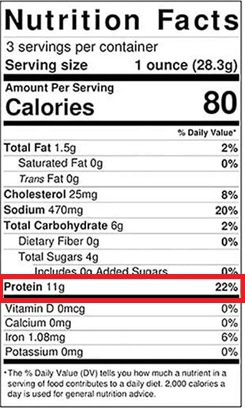
We can see that one serving of People’s Choice beef jerky provides 22% of your recommended daily protein value. This would therefore be considered a “high protein” snack. Understanding how to find the DV number and what it means is a good way to help you determine what a good source of protein is and to understand how much protein is truly in “high protein” foods.
Not All Protein Is Created Equal
There’s a bit more we need to know, however. While companies’ nutrient content claims must be quantitatively accurate, they need not be qualitatively accurate. In other words, not all proteins are created equal. Let’s learn a bit about protein.
Proteins are chains of amino acids. There are about twenty amino acids our body needs to function. Our body naturally produces eleven of these amino acids. Therefore, we don’t need to worry about getting them from food. The other nine, however, we need to get from food, and these are called essential amino acids. Proteins that contain all nine of these essential amino acids are called complete proteins. Not all proteins are complete, though. Some proteins lack one or more of the nine essential amino acids and are known as incomplete proteins.
Incomplete proteins are not bad; the body can still use incomplete proteins by combining them with other incomplete proteins throughout the day to get all the essential amino acids it needs. It does mean, however, that what you get out of each is different; 10 grams of complete protein is “more” than 10 grams of incomplete protein, the way that 10 quarters is worth more than 10 nickels, to use a crude analogy.
All well and good, but how does this relate to food labels and understanding what is a good source of protein?
Understanding Daily Value and Protein
Food companies are only required to report the raw quantity of protein in a product; they are not required to disclose the ratio of complete to incomplete protein. To go back to our coin analogy, it is like someone handing you a box and saying, “There are twenty coins in this box,” but without telling you what types of coins are inside. A product may contain 20 grams of raw protein, but if too much of that is incomplete protein, your body is actually getting less. For example, if you eat a protein bar that advertises 20 grams of protein but it contains high quantities of incomplete protein, you may actually be getting closer to 13 grams.
But if companies do not have to tell us how much protein is complete versus incomplete, how can we understand when we are getting something with complete versus incomplete proteins?
This is where daily value comes in handy! While the FDA does not require these ratios to be divulged, it does require them to be reflected in the product’s daily recommended value (DV). If a protein is complete, 100% of it will be counted towards the DV on the food label; if a protein is incomplete, not all will be counted towards the daily value. DVs are the recommended daily amounts of nutrients an average person needs to consume based on a standard 2,000-calorie diet. For protein, the FDA recommends 50 grams per day. Keep in mind that your actual needs may vary, and 50 grams is simply a baseline average based on a 2,000-calorie diet. People trying to build muscle, for example, should be eating more than this.
It is fortunate that the DV for protein is 50 grams, as that makes the math easy. For example, let’s say a Greek yogurt has 20 grams of protein. If all of it is complete protein, 100% of that 20 grams will count toward your recommended DV of 50 grams. Since 20 grams is 40% of the 50 grams recommended by the DV, the DV will say 40%.
Notice how the DV is exactly twice the number as the amount of protein in the product? We have 20 grams of protein in the yogurt, which accounts for 40% of the DV. That will always be the case if the protein is complete. Let’s look at a real-life example from the label of a Quest protein bar:
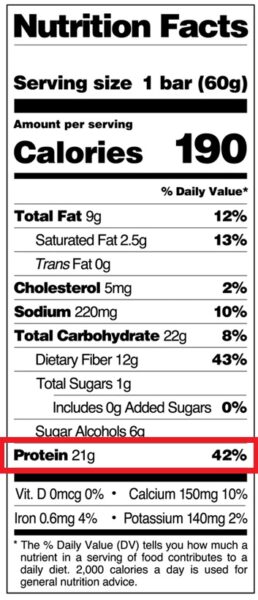
The Quest bar contains 21 grams of protein, accounting for 42% of the recommended DV. Because the percent at the right is exactly twice the number we see on the left, we know that this Quest bar uses complete proteins—since 21 is 42% of 50, that means the entirety of the 21 grams of protein can count towards your DV. The Quest bar is a good source of protein.
Let’s look again at that People’s Choice beef jerky label again:
Again, see how the DV percent is exactly double the number of grams of protein in the jerky? That means that this jerky contains all the complete proteins. All 11 grams of the protein can count towards your daily value. See how easy it is? All you need to do is find the percent DV that equals twice the number of grams.
By contrast, if the proteins are incomplete, the percent DV will not be twice that on the left. Instead, it will be lower, because not every gram of protein can be counted toward the DV. As an example of this, let’s take a look at the label of Kodiak brand protein pancake mix:
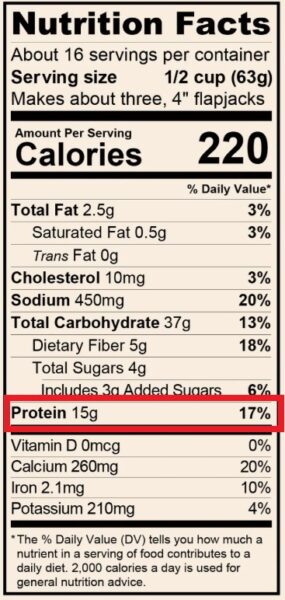
Notice that the Kodiak protein pancake mix contains 15 grams of protein but counts as only 17% of the DV. This means this product contains a lot of incomplete proteins. If we do the math, 17% of 50 is 8.5. That means that of the 15 grams of protein in a serving of this product, only 8.5 of them are complete proteins, about half, or to put it another way, your body is only effectively able to use half of the protein advertised on the label. That’s why only half of it counts towards your DV.
Just to be clear, this does not mean Kodiak protein pancake mix is “bad,” but it does mean it provides considerably less usable protein than a similar product with 11 grams of complete protein.
Intentional Eating
As I said at the outset, the best sources of protein are meats, poultry, and fish, along with eggs and dairy products like Greek yogurt and cottage cheese. Plant-based proteins are good as well, but they are going to have higher degrees of incomplete protein, so if you’re eating a lot of beans, lentils, etc., make sure to mix them up with eggs, dairy, and meats to get the full spectrum of amino acids your body needs. If you are eating prepackaged foods and drinks marketed as “high” protein or a “good source of protein,” check the label to make sure the percent DV number is double the protein grams number, and you can be sure you are actually getting solid protein. It’s a pretty handy rule of thumb that can add intentionality to your eating and help ensure your protein choices are optimal.