The Detective and the Conversion of Alec Guinness
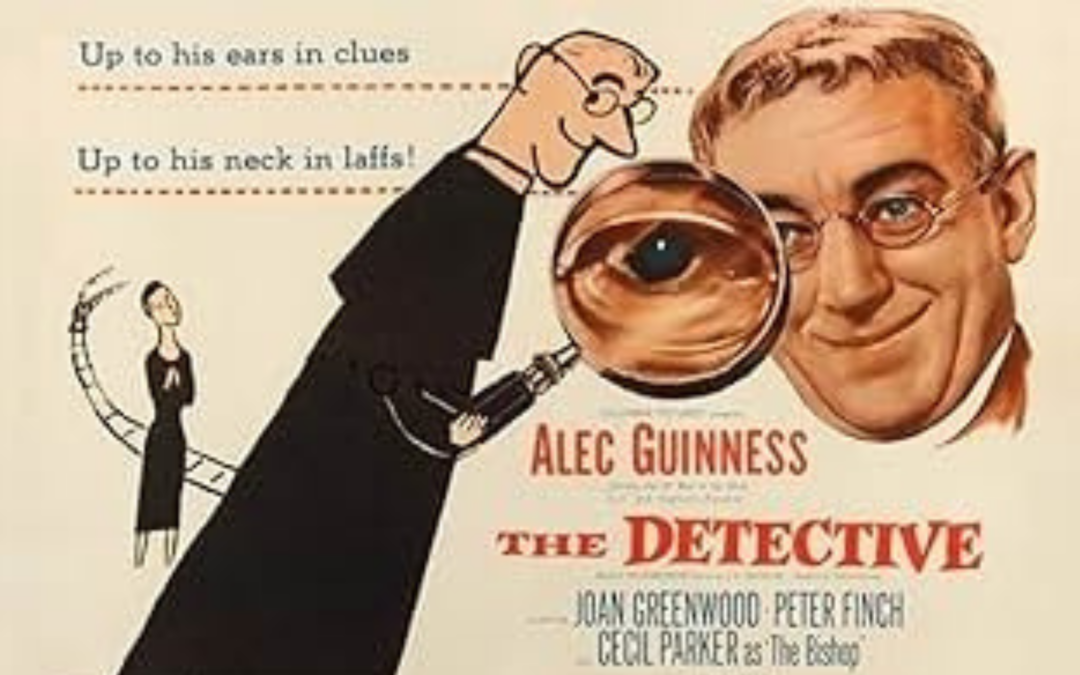
My latest entry in my series on homeschooling through black-and-white film features a movie that should hold particular interest for Catholic viewers: the 1954 British production Father Brown, released in the United States under the title The Detective. Starring Alec Guinness in the title role, the film is based on the beloved priest-sleuth created by G. K. Chesterton. It is not only an entertaining mystery film in its own right but also happens to have been the occasion of one of the most remarkable conversion stories attached to any Hollywood production. But before we talk about the film, we need to talk about Father Brown himself, because understanding the character is essential to appreciating The Detective.
The Father Brown Stories
G.K. Chesterton (1874–1936) created Father Brown in 1910 with the publication of the short story “The Blue Cross,” the same story on which The Detective is loosely based. Chesterton would go on to write over fifty Father Brown stories across five collections, and the little priest became one of the most recognizable detective figures in English literature, standing alongside Sherlock Holmes, Hercule Poirot, and Lord Peter Wimsey. Chesterton’s Father Brown stories have enjoyed popularity across generations that continues to this day.
What sets Father Brown apart from his peers is the source of his detective genius. Holmes deduces from physical evidence; Poirot works by intellectual analysis. Father Brown solves crimes through an intimate knowledge of human nature—a knowledge he has acquired specifically as a confessor. Father Brown understands evil not because he is hardened by worldly experience, but because men have been laying bare their souls to him for decades in the confessional. This is Chesterton’s central apologetical point: no one is better positioned to understand human wickedness than a priest who has spent his life hearing sinners confess it.

(Incidentally, if you’d like to hear a good rendition of the Fr. Brown stories on Audible, check here)
The Detective
The plot of the 1954 film The Detective centers on a priceless relic, the Cross of Saint Augustine, which is being transported from Fr. Brown’s parish in England to Rome for a Eucharistic Congress. The police warn Father Brown that the master thief Flambeau—a man of many disguises whom no one has ever clearly identified—is likely to attempt the theft. Father Brown insists on transporting the cross himself, reasoning that the police would be far too obvious a target.
What follows is a cat-and-mouse comedy of errors across England and France. Father Brown (Alec Guinness) pursues Flambeau (Peter Finch) through a series of disguises and misdirections. The supporting cast is excellent. Joan Greenwood plays the aristocratic Lady Warren, who is eventually enlisted as bait to lure Flambeau into a final trap. Bernard Lee (later famous as M in the James Bond series) plays the exasperated police detective Valentin. And Cecil Parker, who had previously appeared alongside Guinness in The Man in the White Suit, plays Fr. Brown’s sympathetic but exasperated bishop.
One aspect of this film I found unique in the detective genre is Fr. Brown’s motivation. He has no real interest in putting Flambeau in handcuffs. What he wants is Flambeau’s soul. This creates an ongoing tension between Fr. Brown and Inspector Valentine, who cannot fathom a detective who actively works to prevent an arrest. The priest is not pursuing justice in the conventional legal sense. He is pursuing redemption.
The Theme of Redemption
Redemption is the heart of both the original Chesterton story and the 1954 film. Standard detective fiction is fundamentally about restoring order—catching the criminal and closing the case. Fr. Brown operates from a different premise entirely. In his view, capturing the body of a criminal while leaving the soul to rot is not a victory at all. He is far more interested in conversion than conviction. In The Detective, this sometimes results in the comedy of Fr. Brown actually helping Flambeau elude the police, thereby affording the priest more time to work on the thief’s conversion.
This plays out in a series of philosophical duels between Fr. Brown and Flambeau. Flambeau is not presented as a cartoon villain but as an intelligent, even charming man who has convinced himself that his thieving is a kind of game, a demonstration of superior intelligence. Fr. Brown refuses to let that self-flattery stand. Fr. Brown’s argument is not sentimental; it is theological. A man is made for more than this, and wasting one’s God-given gifts on theft is a form of self-destruction, however elegantly done.
The Conversion of Alec Guinness
No discussion of The Detective is complete without the story of what happened to Alec Guinness during and after the production. The tale is well known, but you can find it outlined in Joseph Pearce’s excellent book Literary Converts.
When Guinness accepted the role, he was not a Catholic. In fact, he was a bit suspicious of the Church. His background was difficult: he had grown up in poverty, never knew his father, and suffered under a brutal stepfather. He had been confirmed Anglican at sixteen while privately considering himself an atheist.
Two things happened during the production that began to change him. First, his young son Matthew contracted polio. Guinness, walking past a little Catholic church each evening after filming, began to stop inside to pray. He struck a private bargain with God: if Matthew recovered, he would not stand in the way if his son wished to become Catholic someday.
The second event was a charming encounter with the locals that had a profound effect on him. One evening, still dressed in Father Brown’s cassock and clerical hat, Guinness was walking through the French village when a small boy came running up to him, calling out, “Mon père! Mon père!”—”My Father! My Father!”—and seized his hand. Guinness did not speak French and could not correct the child’s assumption. He simply walked alongside the boy for a time. Later, in his 1986 autobiography Blessings in Disguise, Guinness reflected that a Church capable of inspiring such instinctive trust could not be the scheming, oppressive institution he had imagined it to be.
Matthew did recover. He enrolled in a Jesuit academy and at fifteen announced his desire to become Catholic. Guinness honored his side of the bargain and consented. But as Guinness put it, God wanted more than just his permission. He began studying Catholicism in earnest, made a retreat at a Trappist monastery, had long conversations with a priest, and even attended Mass with Grace Kelly during a film shoot in Los Angeles. In 1956, he was received into the Church by the Bishop of Portsmouth. While he was filming The Bridge on the River Kwai in Sri Lanka the following year, his wife quietly converted as well, a development he described as one of the great surprises and joys of his life.
Guinness died in 2000, a practicing Catholic to the end. In his autobiography, he credited Chesterton’s Father Brown with setting him on the path to Rome.
My Recommendation: Give The Detective a Watch!
The Detective (Father Brown) is one of the most rewarding films I’ve watched in this blog series, and I give it my full recommendation. Unlike some of the other films I have covered, it does not require much in the way of historical unpacking or sociological context. It simply works as a film—funny, intelligent, warm, and genuinely Catholic in spirit without being preachy. Guinness is marvelous in the role. He plays Father Brown as a benign, mildly befuddled figure who turns out to be the sharpest mind in every room he enters, which is exactly right. Peter Finch’s Flambeau is a worthy adversary, and the French location photography gives the film a cinematographic authenticity impressive for a low-budget 1950s production.
For Catholic homeschooling families, the film offers multiple entry points: a discussion of Chesterton’s apologetics, an exploration of confession and mercy as Catholic distinctives, a meditation on what it means to pursue the conversion of a sinner rather than merely his punishment, and the edifying true story of how a role in a movie became the occasion for one of the most celebrated conversions of the twentieth century.
Add a few Father Brown short stories as companion reading, and you have a genuinely rich unit study. One might even pair a viewing of The Detective with assigned readings from Chesterton’s Orthodoxy or The Man Who Was Thursday for older students, or with the Fr. Brown short stories themselves, which are readily available and entirely appropriate for high school readers. The film’s themes of confession, conscience, and the accessibility of grace are good material for discussion.
The film is freely available on YouTube and various streaming platforms.
Continuing the Discussion
Families who enjoy the Father Brown stories and classic detective fiction may also appreciate Homeschool Connections’ recorded courses taught by Eleanor Nicholson: The Victorian Detective and The Golden Age of Mystery Fiction. These engaging literature courses explore the development of detective fiction, memorable sleuths, and the enduring appeal of mystery stories from the Victorian era through the twentieth century. Both courses are available through Unlimited Access and Single Access and would make excellent companion studies for students inspired by Chesterton’s Fr. Brown tales and classic mysteries in general.
What are your thoughts on this topic? I invite you to join other homeschooling parents and me in the Homeschool Connections Community or our Facebook group.
NOTE: This article contains affiliate links.