Stoicism Explained: Principles, History, and Catholic Insights
This is the twelfth article in a series. To learn more, see: “The -Isms Encyclopedia: Historical and Philosophical Ideas Explained” by Mr. Phillip Campbell.
Not long ago, I walked into my son’s room and found him stretched out on his bed, deep in a book. This alone was not unusual—he reads every day—but I was curious what he was so immersed in. I leaned over and read the spine: it was my personal copy of Marcus Aurelius’s Meditations, he’d pulled from the philosophy section in my personal library. I was pretty stoked. “Whoa, you’re reading Aurelius?” I exclaimed.
“Yeah, I heard some other kids talking about it online. It’s actually pretty good,” he said. Not only was he spending his free time reading an ancient philosopher, but apparently, many other young men were as well.

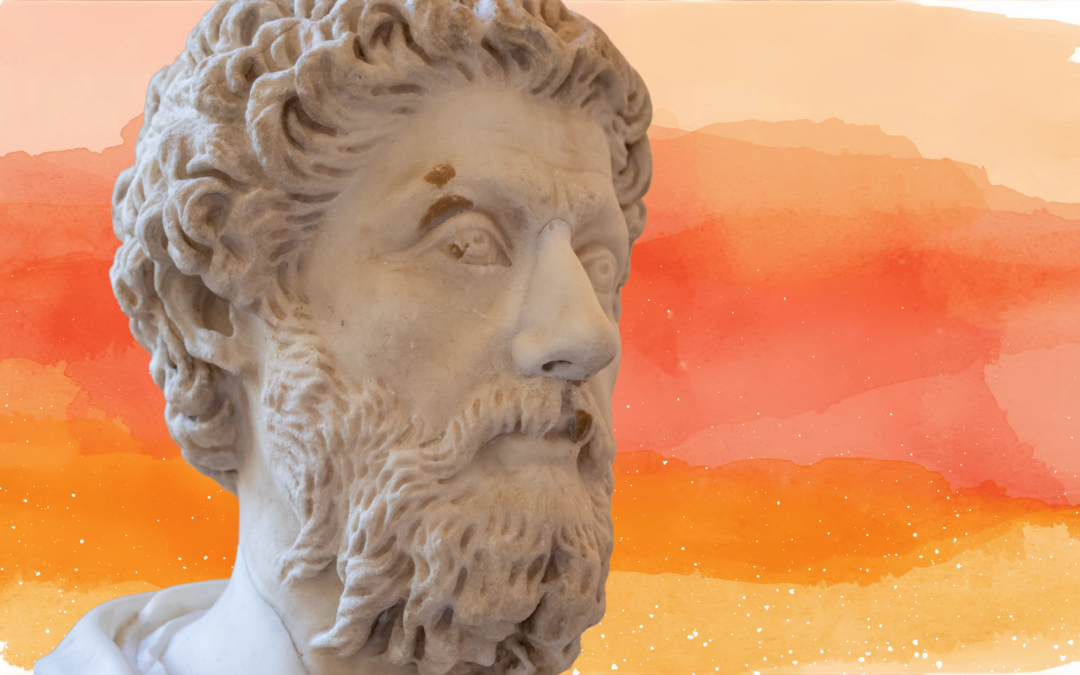
Marcus Aurelius, Stoic
Marcus Aurelius was the Emperor of Rome from 161 to 180 AD and one of the most powerful men who had ever lived. He presided over Rome at the apex of its power. And yet, the private journal Aurelius kept for his own spiritual discipline is a record of relentless self-examination, humility, and the effort to master his own passions. “You have power over your mind, not outside events,” he wrote. “Realize this, and you will find strength.” I think it is this image of the man of power who chooses self-restraint, the ruler who refuses to be ruled by his appetites, that appeals to a young man trying to figure out what kind of person he wants to be.
Aurelius was a proponent of an ancient ethical philosophy known as Stoicism. It would be wrong, however, to consider Stoicism as a relic of antiquity, for it has never really gone away. In recent years, there’s even been a popular revival of Stoicism, especially among young men. Books like Ryan Holiday’s The Obstacle Is the Way and podcasts referencing Marcus Aurelius, Epictetus, and Seneca have brought Stoic ideas to a new generation that finds them counter-cultural. In an age that seems to pander to everybody’s vices and weaknesses, Stoicism stands out as a philosophy that tells you to stop complaining, master yourself, and endure difficulty without flinching. In a cultural moment saturated with talk of victimhood and emotional fragility, Stoicism feels like a cold, clean splash of reality.
So what exactly is Stoicism? Where did it come from? What does it teach? And what should Catholics make of it?
What is Stoicism?
Stoicism is a philosophical school founded in Athens around 300 BC that teaches the cultivation of virtue and rational self-discipline as the path to the good life. Its name comes from the Stoa Poikile—the Painted Porch—a colonnaded walkway in the Athenian agora where its founder, Zeno of Citium, taught his students. Stoicism would spread throughout the Greek-speaking world, take deep root in Roman culture, and shape Western civilization for centuries. In one form or another, its ideas about self-mastery, duty, and the acceptance of what we cannot control have become fundamental ideals of Western civilization.
Stoicism is a complete philosophical system, encompassing logic, natural philosophy, and ethics. In practice, however, most people who encounter Stoicism—ancient or modern—are drawn primarily to its ethics: its account of what makes for a good and worthwhile human life.
Principles of Stoicism
The principles of Stoicism are tightly interconnected. They begin with a claim about the nature of reality and flow logically into a vision of the good life.
The Logos
At the foundation of Stoic thought is the concept of the Logos—a Greek word meaning “reason,” “word,” or “rational principle.” The Stoics held that the entire universe is governed by a single, all-pervasive rational force, which they called the Logos or sometimes simply “God” or “Nature.” This is not a personal deity who loves and acts, as in Christianity. It is more like the rational structure of reality itself: an impersonal divine reason that holds everything together and directs everything toward its proper end. For the Stoics, the universe is not a chaos of random events but a perfectly ordered whole.
Virtue as the Sole Good
The Stoics argued that virtue is the only true good and the only thing genuinely capable of making a person happy. Everything else (wealth, health, reputation, pleasure, even life itself) falls into the category of adiaphora, meaning “indifferent things.” These externals are not evil, but none of them can make you truly happy or truly miserable. Only the quality of your inner moral life can do that.
To Live According to Nature
Because human nature is fundamentally rational, and because the rational Logos orders all of reality, the good life consists in bringing our will into alignment with the rational order of the cosmos. This means accepting what we cannot change, fulfilling our duties to family and community, and cultivating a character defined by the four cardinal virtues the Stoics prized: wisdom, justice, courage, and temperance.
What We Can Control vs. What We Can’t
Epictetus taught a simple but powerful division: some things are “up to us”—our judgments, desires, and intentions—and some things are not, such as our bodies, reputations, and other people’s actions. Misery arises from confusing these two categories. The Stoic practice of distinguishing what is within our power from what is not liberates the Stoic from anxiety. Incidentally, cognitive behavioral therapy, one of the most widely used forms of modern psychotherapy, draws heavily on this Stoic insight.
Mastery of the Passions
The Stoics taught that some emotions were destructive, such as fear, grief, lust, and excessive desire. These arise from false judgments about what is good and bad. Because the virtuous person has correctly understood that externals are indifferent, he is not disturbed by them. The Stoics called this state of inner calm apatheia—not exactly the same as our English “apathy,” but more akin to a disciplined freedom from irrational emotional disturbance. Their goal was not emotional deadness, but the replacement of false passions with what the Stoics called eupatheiai: a rational joy in virtue, good will toward others, and delight in what is genuinely good. Stoicism is often portrayed as a philosophy opposed to emotions. This is untrue; it is better to say it is a philosophy that restricts the scope of emotions.
Who’s Who of Stoicism
Stoicism developed over roughly five centuries and went through three distinct phases: the Old Stoa of the Greek founders, the Middle Stoa that brought it to Rome, and the Roman Stoa that produced the writers most familiar to us today.
Zeno of Citium (c. 334–262 BC)
Zeno was a merchant from Cyprus who came to Athens after a shipwreck and stumbled into a bookshop where he read the works of Socrates. He was so captivated by philosophy that he sought out teachers and eventually began teaching his own philosophy in the Painted Porch around 300 BC. Zeno was renowned for practicing what he preached. He had a reputation for being abstemious, serious, and relentless in pursuit of self-discipline.
Chrysippus (c. 279–206 BC)
If Zeno founded Stoicism, Chrysippus systematized it into a coherent philosophical system. An extraordinarily prolific writer, Chrysippus worked out the logical, physical, and ethical implications of Stoic teaching. The ancient saying was: “If there had been no Chrysippus, there would have been no Stoa.”
Seneca (4 BC – 65 AD)
Seneca was a Roman statesman and philosopher who served as tutor and advisor to the Emperor Nero. His philosophical letters and essays are among the most readable of all Stoic texts, known for their wittiness and common-sense observations about human nature. He eventually ran afoul of Nero and was forced to commit suicide.
Epictetus (c. 50–135 AD)
Epictetus was a Greek slave in Rome whose master, a freedman of Nero named Epaphroditus, reportedly broke his leg to test his endurance. Epictetus replied calmly, “I told you it would break. Did I not tell you?” His Enchiridion (“The Manual”) presents Stoicism in its most concentrated form, insisting that freedom is always an interior state; i.e., that no one can truly enslave a person who has mastered his own soul.
Marcus Aurelius (121–180 AD)
Marcus Aurelius was Emperor of Rome from 161 to 180, governing through a period of continuous warfare, a devastating plague, and persistent political treachery. His Meditations—a private spiritual journal he never intended for publication—record his daily effort to remain humble, patient, and dutiful despite holding the most powerful office in the world. They have never gone out of print and are the most popular Stoic texts.
Stoicism in Practice
Stoicism was enormously influential in the ancient world. It shaped the ethos of the Roman Republic and Empire, informed Roman law’s concept of universal human dignity, and gave Roman statesmen and soldiers ideals of duty, self-sacrifice, and the acceptance of fate. The Roman virtues of gravitas, constantia, and pietas (seriousness, steadfastness, and devotion to duty) owe much to the Stoic tradition. It has been called the official philosophy of the Roman Empire.
In the early Christian era, Stoicism was taken seriously by many Church Fathers as a philosophy that had made some progress toward genuine truths, even without the benefit of Revelation. Justin Martyr wrote of the logos spermatikos—the “seed of the Logos”—as present among pagan thinkers, including the Stoics. Clement of Alexandria and Origen discussed Stoic ideas extensively. Augustine quoted Seneca with approval. Early Christian thinkers understood that Stoicism had valuable insights about human nature, even if it was imperfect as a comprehensive philosophy of life.
Stoicism largely faded as a formal school in late antiquity, but its ideas survived through the medieval period, particularly its natural law theory, which passed through Cicero and the Roman juridical tradition into the work of St. Thomas Aquinas.
In the modern era, Stoicism has experienced a notable revival. Its practical techniques for managing adversity, emphasis on reason over emotion, and demand for personal responsibility have found a wide audience in military, athletic, fitness, and self-help communities. The fact that Stoicism offers a serious ethical framework without religious premises makes it attractive in a secular age. It is essentially a conservative view of human nature—that we are not simply products of our circumstances, but agents responsible for our own inner lives—that gives it a counter-cultural edge. Stoicism remains a potent intellectual force in the world today.
From a Catholic Perspective
Common Ground
There is genuine common ground between Stoicism and Catholicism, more than one might expect between a pagan philosophy and the Christian faith. The Stoics rightly identified virtue as the highest human good, anticipated the concept of natural law, and affirmed the fundamental equality and dignity of all human beings as sharers in the divine Logos. Additionally, they demonstrated that reason, rightly ordered, can perceive important moral truths without special revelation. St. Thomas Aquinas incorporated Stoic natural law thinking into his moral theology, and the Stoic vocabulary of the four cardinal virtues—prudence, justice, fortitude, temperance—became standard in Catholic ethical teaching.
Nature of Logos
But there are also fundamental divergences. The most significant concerns the nature of the Logos itself. For the Stoics, the Logos is an impersonal rational force immanent in the world—essentially pantheistic, identifying God with Nature. For Christians, the Logos is personal: “In the beginning was the Word, and the Word was with God, and the Word was God” (John 1:1). The Logos became flesh in Jesus Christ. This is an enormous difference. A universe governed by an impersonal rational force makes no demands on us except to be rational; a universe created and sustained by a personal God who loves us and became one of us makes a vastly more radical claim.
What is Happiness
Second, the Stoics held that virtue is entirely sufficient for human happiness. For the Stoic, the truly wise person needs nothing outside herself to be fully flourishing. Catholicism agrees that virtue is essential, but insists that human beings have a supernatural end that exceeds what nature alone can achieve. We are made not merely to be virtuous but to be united with God, and this union requires not just effort and self-discipline but grace—the free gift of God’s own life poured into us through the sacraments. The Stoic sage is radically self-sufficient; the Christian is radically dependent on God.
What is Suffering
Third, the Stoic treatment of the passions, while containing real wisdom, tilts too far toward suppression. The Stoic ideal of apatheia (freedom from emotional disturbance) risks treating our capacity for feeling as something to be quarantined rather than ordered and redeemed. Catholicism, shaped by the doctrine of the Incarnation, insists that matter and emotion are fundamentally good; Christ himself wept at Lazarus’s tomb and sweated blood in Gethsemane. We are not called to be unmoved by suffering but to unite our suffering with His. There is a world of difference between Stoic composure and Christian hope.
What is Death
Finally, the Stoic treatment of death demonstrates the philosophy’s shortcomings. The Stoics argued for a calm acceptance of death as a natural event, and some—Seneca most famously—treated suicide as a legitimate escape from intolerable circumstances. For Catholics, death is not the end but a passage, and the body is sacred. Therefore, Christians are not called to accept death with detachment but to await resurrection with hope.
There is true wisdom Catholics can draw from Stoicism: the emphasis on virtue, the discipline of distinguishing what is in our control from what is not, and the cultivation of courage and equanimity. But Stoicism, left to itself, is a philosophy of self-reliance, while the Gospel teaches us that the beginning of wisdom is knowing we cannot save ourselves.
In the Homeschool Connections Catalog
Several Homeschool Connections courses engage with themes relating to Stoicism, including:
- Virtue and Vice: Ancient Philosophy for Modern Catholics with Dr. Sam Nicholson
- Philosophy of the Human Person with Dr. Sam Nicholson
- Glory of Ancient Greece with Phillip Campbell
- Christ and Caesar with Phillip Campbell
- How to Battle Relativism, Nihilism, and Other Errors with Dr. Sam Nicholson
Note that while adults cannot take our LIVE interactive courses, they are welcome to take the self-paced recorded versions through our Unlimited or Single Access programs.
Final Thoughts
Stoicism’s enduring appeal (especially to young men) is not hard to understand. It is a philosophy of seriousness. It tells you that your character is your responsibility, that difficulty is an opportunity rather than an excuse, and that the highest thing a human being can achieve is a noble and disciplined soul. These are truths. Consequently, Stoicism deserves credit for recovering them from the heap of self-indulgence that surrounds us.
But the Stoic sage, wise as he is, ultimately remains alone. He has mastered himself, but he has no one to love him back, no Logos who became flesh and died for him, no sacraments to lift him above what he could achieve by his own effort. Stoicism is best considered as a noble preparation for the Gospel, but it is not a final destination. The goal of Catholic education is not to produce a young man who has read Marcus Aurelius and steeled himself to endure whatever comes. The goal is to produce a young man who has read Marcus Aurelius, recognizes the genuine wisdom there, yet understands why that wisdom stands in need ot the Gospel to complete it.
What are your thoughts on this topic? Join other homeschooling parents and me in the Homeschool Connections Facebook Group or in the HSC Community to continue the conversation.