
St. Fidelis of Sigmaringen: From Lawyer to Martyr
How Ordinary Faith Became Extraordinary: The Story of St. Fidelis
For years, I overlooked the martyr St. Fidelis of Sigmaringen. That was a mistake. When I finally learned his story, I found a powerful example of how ordinary faith can lead to extraordinary courage.
It was when I was writing Story of Civilization Volume 3 that I discovered St. Fidelis while researching the saints and martyrs of the Reformation. I was so moved by his life that I included the tale of his martyrdom as a historical fiction vignette (Chapter 23 of SOC Volume 3). As we approach the feast of St. Fidelis on April 24th, I’d like to share a bit of his story with you…

The Poor Man’s Lawyer
Fidelis was born in 1578 in the small South German town of Sigmaringen. His birth name was Mark Rey. Young Mark was bright, ambitious, and serious about his faith. He studied philosophy and law at Freiburg, earned his degree, and then did something rather unusual for a newly minted lawyer. He spent several years traveling as a tutor to a group of young noblemen, wandering through France, Spain, and Italy. It was an opportunity for Mark to see a bit of the world and gain experience abroad. Importantly, this was during the heyday of the Reformation, and Mark Rey was troubled by the religious disorders he saw in Christendom.
Mark was also troubled by the legal profession’s messiness. Through his practice of law, he began to notice that the courts were rigged in favor of whoever could pay the most. This made him indignant, and he resolved to always defend the rights of those who could not help themselves. In fact, he became known as “the poor man’s lawyer.”
But something deeper was stirring in his soul. Around 1612, after his return to Freiburg to practice law, Mark Rey made the decision that would define the rest of his life. He entered the Capuchin Franciscans. He was thirty-four years old when he entered the Capuchin Franciscans. At that point, he gave away everything he owned to the poor and took the name Fidelis, meaning “faithful.”
The Preaching Friar
As a friar, Fidelis became exactly what his name promised. He was famous for his penances, his long hours of prayer, and his absolute fearlessness in serving the sick. During one of the periodic outbreaks of the plague that so frequently troubled Europe in those days, Fidelis ministered to the sick while many others fled. There is a popular quote attributed to St. Fidelis that served as his personal motto: “Woe to me if I should prove myself but a halfhearted soldier in the service of my thorn-crowned Captain.”
In 1622, his Capuchin superiors gave Fidelis a dangerous assignment. The Graubünden, a mountainous region of what is now Switzerland, had become a hotbed of Calvinist preaching and anti-Catholic agitation. Fidelis was sent to warm people’s hearts towards Catholicism and win some back to the Church. Fidelis went and preached and, by all accounts, proved remarkably effective as a missionary. Consequently, this marked him as an enemy of the Calvinist leadership of the Graubünden.
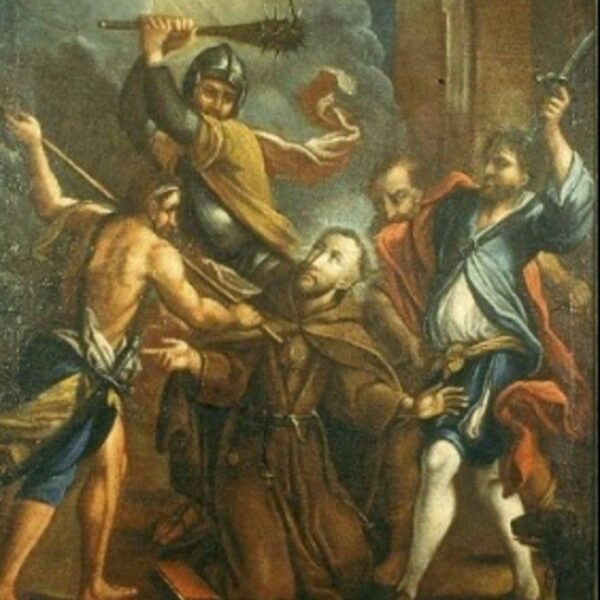
The Martyrdom of St. Fidelis
On April 24, 1622, Fidelis went to preach at the village of Seewis. There was a protest at the church. A Calvinist even discharged a musket at him while he was preaching. Fidelis was urged by his friends to leave for his own safety, and so he departed for a neighboring village. On the road, he was confronted by a Calvinist mob. They demanded he renounce Catholicism and embrace Calvinism. Fidelis replied, “I am sent to you to confute, not to embrace your heresy. The Catholic religion is the faith of all ages. I fear not death.” The mob fell upon him and beat him to death. Before he expired, he uttered a prayer for their forgiveness. He was forty-four years old.
Fidelis was beatified in 1729 and canonized in 1746 by Pope Benedict XIV, making him the first martyr to be canonized after the Council of Trent. His feast day is April 24, the anniversary of his death.
An Ordinary Life Transformed by Grace
When I first read this story, what struck me was that St. Fidelis was neither a mystic nor a nobleman; he had nothing extraordinary about his youth or upbringing. He was in every respect just an ordinary professional. a boring lawyer with a good career and a comfortable future. But the way grace worked in his life constantly drew him to higher things until he entered religious life. His ten years as a Capuchin further formed him in holiness until the pivotal moment came, and he was able to lay down his life for the faith unhesitatingly.
The Power of Grace in Everyday Lives
St. Fidelis’s story is a fine example of how the slow working of grace in a willing soul can transform an average person into a vessel of sanctity capable of doing great things for the glory of God.
Oh, one final piece of the story—the Calvinist preacher who had riled up the locals against St. Fidelis later repented of his actions, renounced his heresy, and was received into the Catholic Church. Perhaps he and St. Fidelis are in heaven together now, laughing about the whole thing.
What are your thoughts on this topic? Are there other little-known saints you’d like me to write about? I invite you to join the discussion with other homeschooling parents and me in the Homeschool Connections Community or our Facebook group.
NOTE: This article contains affiliate links.