
Lapbooking Ideas for Homeschooling: A Creative Way to Boost Learning
Delving into Lapbooking
Everyone hits a homeschooling rut once in a while. You can get burned out on the same old subjects, same old books, same old assignments. Creativity gives way to routine, inspiration to monotony, and ambition to just checking boxes.
Sometimes what we need is a way to shake up our routine assignments with some creativity that helps us and our children reconnect with the love of learning. If you could use a creativity boost, maybe lapbooking is your answer!

What is Lapbooking?
Lapbooking sounds like scrapbooking, and there are similarities between the two. Like scrapbooking, lapbooking is a creative way to organize material, with the difference that it focuses on displaying academic knowledge rather than preserving memories.
A lapbook is a hands-on, interactive project created by a child to organize and showcase what they have learned about a specific topic. A typical lapbook is made from a file folder and contains mini-books, charts, diagrams, and other creative elements that are glued inside, making it a visual, 3D summary of a subject. Creating the lapbook helps students retain information, develop research skills, and stay engaged by turning information into a personalized, creative collection. It also helps them think about how content is best organized for understanding and presentation. The lapbook is basically a smaller, more easily portable version of the old poster board presentation projects many of us had to do in our own schooling.
Here are some examples of lapbook projects:
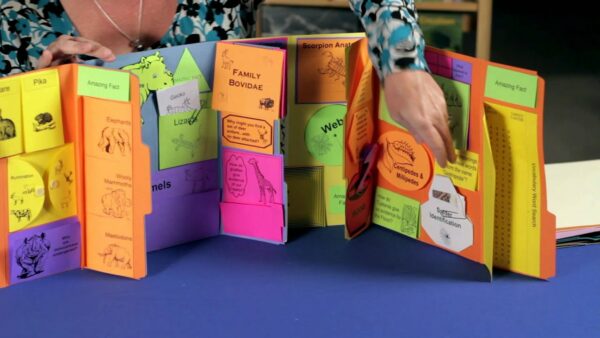 (Courtesy of Knowledge Box Central)
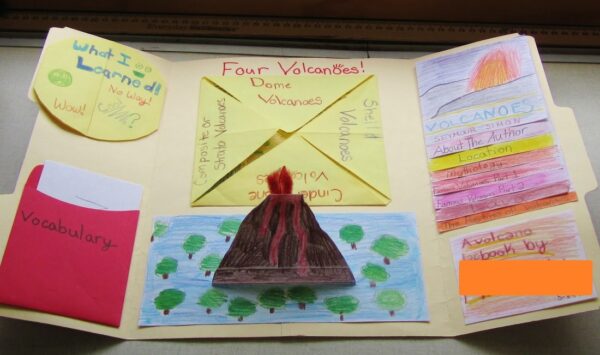 (From “Mrs. Colley’s Plant Classification Lapbook Project“)
 (Courtesy of Homeschool Share)
What Sorts of Topics Make for Good Lapbooks?
A typical lapbook is full of flaps, charts, pockets, and organizational design elements. This makes it especially suitable for subjects with lots of sub-topics, vocabulary, facts, timelines, maps, diagrams, or hands-on elements. These sorts of subjects work great because kids can cut, fold, glue, and organize information in a very visual, tactile way.
Some subjects that work great for lapbooking include:
-
- Human Body Systems (skeletal, digestive, circulatory, nervous, etc.)
- Animal Classification (mammals, reptiles, birds, insects, or in-depth on a particular animal like sharks, butterflies, penguins)
- Life Cycles (butterfly, frog, chicken, plant, pumpkin, apple, etc.)
- Biomes or Habitats (rainforest, desert, ocean, tundra, grassland)
- Ancient Civilizations (Egypt, Greece, Rome, Mesopotamia, Maya, etc.)
- U.S. States or Countries of the World
- Planets & Solar System
- Weather / Water Cycle / Clouds
- Famous Inventors or Scientists (Edison, Einstein, Marie Curie, etc.)
- Bible Stories or Saint Character Studies
- Parts of Speech / Grammar Rules
- U.S. Presidents or Famous Historical Figures
- Dinosaurs (types, periods, extinction theories)
- Ocean Zones & Sea Creatures
- Plants & Photosynthesis
Really, though, any subject can work with the right amount of ingenuity. The sweet spot is breaking the subject down into 8 to 15 subcategories (without feeling forced) that can turn into mini-booklets or flaps with lots of visuals. With the right amount of forethought, even mathematical concepts like fractions can be displayed in a lapbook.
What Do I Need To Get Started Lapbooking?
The great thing about lapbooking is you don’t need much–just a few basic supplies that you might already have lying around or can pick up inexpensively.
The essential lapbooking item is simply one or more file folders. Standard letter-size manila or colored ones work perfectly. You’ll usually use two or three folded and glued together to create a larger base with multiple panels. You’ll also want plenty of printer paper or cardstock for printing or creating the mini-books, flaps, pockets, and accordions that go inside. Scissors, a glue stick, and clear tape are must-haves for cutting and securely attaching everything. Colored pencils, crayons, or markers let the kids decorate and illustrate their work. Conversely, a black pen or fine-tip marker is great for titles and labeling. Additionally, a ruler helps with straight folds and measuring, and a stapler comes in handy for making small booklets.
Depending on how creative your kids want to get, there are optional but very useful extras you can use. This can include a paper trimmer or guillotine cutter for clean edges, double-sided tape for stronger holds, stickers or washi tape for decoration, brads (split pins) for spinners or movable parts, and envelopes or ziplock bags to turn into pockets.
Lapbooking Templates
For children who prefer it, there are plenty of pre-made lapbooking templates available online. You can find lapbooking templates for free and for purchase on sites like Teachers Pay Teachers, Homeschool Helper, or Homeschool Share (Kathy Duffy also has a review of multiple lapbook kits for your perusal) Lapbooking templates are great for kids who enjoy the tactile aspects of lapbooking—the cutting, gluing, folding, etc.—but are not so big on the creative or conceptual side. The templates allow them to enjoy filling in and assembling the lapbook without the mental labor of designing it themselves. They are also helpful if you, the parent, do not consider yourself especially crafty or artsy.
Scaling Up Lapbooking for Older Children
Based on the emphasis on cutting and gluing and the examples we’ve shared above, you may be thinking, “That’s great for little kids, but how can I lapbook with older children?”
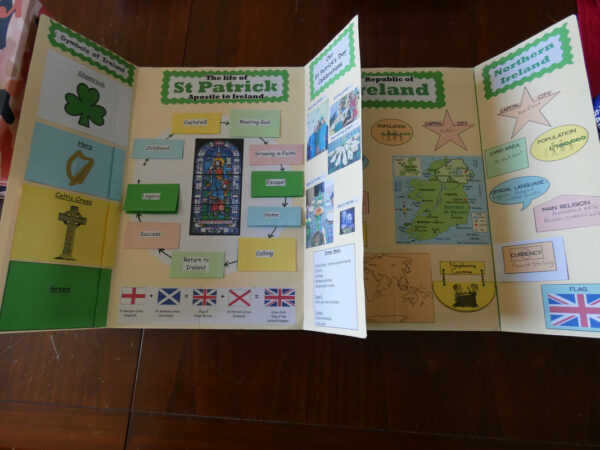
Lapbooking can be scaled up to the high school level with relative ease. High school lapbooking emphasizes research, analysis, and sophisticated design. Teens will want to use larger bases (four to eight folders or even tri-fold boards) and replace basic minibooks with more complex interactive elements—for example, multi-tabbed accordions, primary-source pockets, spinning comparison wheels, layered timelines, and shutter-fold Venn diagrams. Students can even incorporate scholarly citations, annotated bibliographies, short essays, infographics, QR codes to original documents, and typed, color-coded layouts. The finished product becomes a polished, portfolio-quality project ideal for final exams, a National History Day competition, or college application supplements while remaining hands-on and creative.
Here is a nice example of a more sophisticated high school lapbook project on St. Patrick (courtesy of Cyntha Hancox):
The Value of Lapbooking in Homeschooling
At the outset of this article, I introduced lapbooking as a possible antidote to the doldrums of monotony we all sometimes fall into in our homeschooling journey. Honestly, though, lapbooking is a great practice to incorporate, even if you’re not bored with your routine.
Lapbooking brings remarkable value to homeschooling by blending hands-on creativity with deep academic retention in a single project. It reinforces research, writing, organization, and design skills while allowing children of multiple ages to work on the same topic at their own depth—younger students focusing on basic facts and illustrations, older ones adding analysis and sources. Because the final product is a personalized, tangible keepsake that children can display and revisit, lapbooking turns review into something joyful rather than tedious. The tactile nature of the work improves long-term memory and gives parents a beautiful, portfolio-ready demonstration of learning across every subject without relying solely on worksheets or tests.
What are your thoughts on this topic? Join other homeschooling parents and me in the Homeschool Connections Facebook Group or in the HSC Community to continue the conversation.