
The Hidden Health Problem Homeschoolers Shouldn’t Ignore
As homeschooling parents, we spend a lot of time thinking about our children’s intellectual and spiritual growth. We carefully choose math, literature, history, and religion curriculum. However, physical education is too often an afterthought.
Our bodies are gifts from God. Teaching our children the importance of strength, movement, and lifelong fitness is just as much a part of preparing them for adulthood as teaching them to read or solve algebra problems. Plus, healthy habits can become family habits. It is my hope that this series of homeschool PE articles will help you model the lifestyle you hope your children will embrace for the future.
Simple Exercises Every Homeschooler Should Learn
Since May of this year, I have been working on the side as a personal trainer at a medically integrated gym in my area. Medically integrated means the gym is part of a hospital complex. As such, I see a lot of clients who have chronic health conditions, are recovering from injuries, or are just plain out of shape.

Though they have a wide range of conditions, there is one thing I have noticed that almost everyone who walks through the gym door is dealing with. I’m talking about weak glute muscles.
In this article, we will discuss the gluteus muscles, why they are often weak, and ways to strengthen them at home.
What are the Glutes?
Simply put, your glutes (gluteal muscles) are the muscles in your buttocks. The gluteal muscles consist of three distinct muscles—the gluteus maximus, medius, and minimus. Together, they are responsible for propelling the body forward, stabilizing the pelvis during movement, maintaining proper posture, and supporting the lower back. They are thus tremendously important for balance, stability, and lower-body movement. Many basic movements, like walking up the stairs, squatting, or even just standing upright and walking, depend on the glutes.
Why Do People Have Weak Glute Muscles?
The purpose of the glutes is to propel us forward and stabilize the body during movement. In order to keep the glutes strong, we need a healthy dose of physical movement. The problem, however, is that today so many people live sedentary lives that the glutes do not receive adequate exercise. We are increasingly spending more and more time sitting down and working from chairs, so most of us do not get sufficient daily movement to keep the glutes active. The rise of sedentary lifestyles has become something of a health crisis; the World Health Organization estimates that about 1 in 4 Americans get so little daily physical activity that they are classified as “physically inactive” (source).
Given enough time, this can cause something called “chair butt”. “Chair butt” is a casual, non-medical term for gluteal muscle atrophy and deconditioning caused by prolonged sitting—basically, having super weak glutes. It leads to flattened, weakened, or sagging buttock muscles, and is sometimes referred to as “dead butt syndrome” or “gluteal amnesia.” If it goes unaddressed, it can cause all sorts of problems down the line, including:
- Postural problems, such as hunching over
- Lower back pain
- Runners’ knee and general knee pain
- Hamstring strains
- Hip bursitis
- Piriformis syndrome
- Progressive loss of balance
This last one can be pretty serious. Often, when elderly people fall, it is because their glutes give out. A person with weak glutes is going to be increasingly prone to lose balance and injure themselves as they grow old.
The good news is that the glutes respond very well to training in most people, provided they use targeted exercises, proper execution, and progressive overload. Because the gluteus maximus is the largest muscle in the human body, it possesses a high capacity for both strength gains and muscle growth.
Training Your Glutes At Home
Here are three exercises you can do at home to begin strengthening your glutes and saying goodbye to dead butt syndrome!
1. Glute Bridge
The glute bridge is a very basic glute-strengthening exercise you can do with your bodyweight. It doesn’t require anything but a place to lie down!
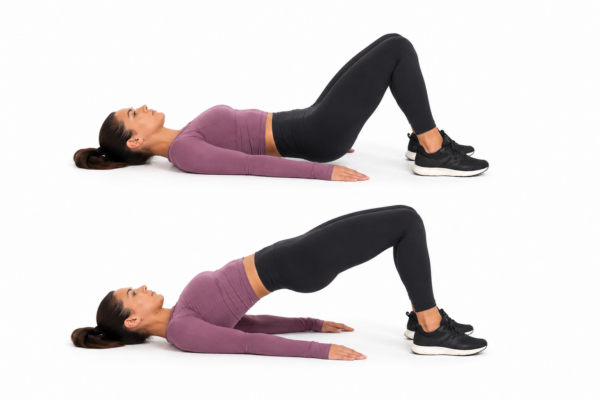
To do a bodyweight glute bridge:
- Lie on your back on the floor with your knees bent and feet flat, about hip-width apart, heels close enough to your hips that your fingertips can just brush them.
- Rest your arms at your sides for support, then push through your heels to lift your hips toward the ceiling, squeezing your glutes hard at the top so your body forms a straight line from shoulders to knees.
- Hold that top position for a second or two, then lower your hips back down with control until they nearly touch the floor, and repeat.
Reps and Sets: Start with 10-15 repetitions for 2-3 sets to get a feel for the motion
Tips: Keep your chin slightly tucked and avoid arching your lower back excessively at the top; the movement should come from your hips, not from overextending your spine.
2. Box Step Ups
The box step-up is an easy movement that uses a stepping motion to work your glutes by forcing them to contract and extend your hip as you drive your body upward onto the elevated surface. You can begin with bodyweight and advance to holding dumbbells, if you have them.
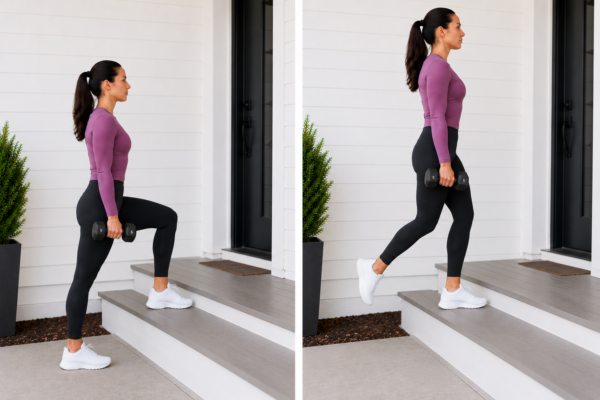
To perform a box step up:
- Find a sturdy chair, a staircase, or any stable elevated surface roughly knee height.
- Stand facing the step or chair seat, place your entire right foot flat on top of it, and press through that foot to lift your body up until your right leg is straight and your left foot is off the ground, hovering just above the step.
- Lower yourself back down slowly and with control, tapping your left foot lightly on the floor before repeating
- Complete all your reps on one side before switching legs.
Reps and Sets: Start with 8-10 reps per leg, and hold onto a wall or railing nearby if you need extra balance.
Tips: Keep your chest upright throughout the movement, avoid pushing off with your bottom foot to propel yourself up, and make sure the surface you’re using is stable and won’t slide or tip. Be extra careful if you are using dumbbells.
3. RDL (Romanian Dead Lift)
The Romanian deadlift (RDL) works your glutes by loading them through a hip hinge, where they contract to pull your torso back upright from a forward-bent position. You can start with bodyweight, but you really need to go on to dumbbells to maximize its benefits. The RDL takes a bit of getting used to, but once you perfect the form, it is an amazing exercise that not only strengthens the glutes but works the hamstrings and improves overall balance!
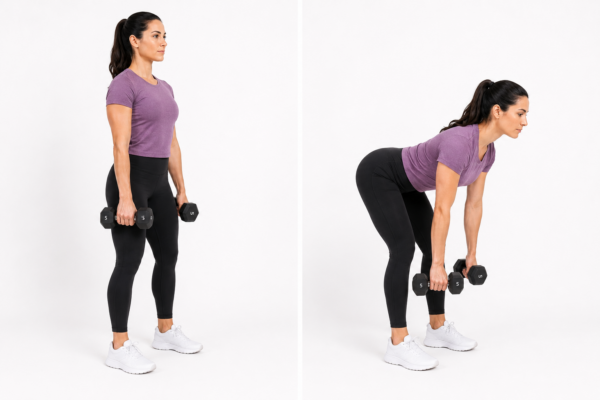
To perform an RDL:
- Stand with your feet hip-width apart and a slight bend in your knees that you’ll maintain throughout the movement.
- Hinge forward at your hips, pushing your butt back behind you while keeping your back flat and your chest up, and let your torso lower toward the floor as your hips move backward. Your hands can slide down the front of your thighs and shins as you lower, or reach toward the floor, going only as far as your flexibility allows while keeping that flat back.
- Once you feel a stretch in your hamstrings, or your torso is roughly parallel to the floor, drive your hips forward and squeeze your glutes to return to standing.
Sets and Reps: Start with 10-12 reps for three sets
Tips: Focus on the hip hinge pattern rather than depth, and keep the motion slow and controlled throughout.
Building Strength at Home
Weak glutes seem to be a cost of modern sedentary life, but they don’t have to stay that way. The three exercises above will give you a solid foundation for rebuilding strength in one of the body’s most important muscle groups, and they can all be done at home with minimal or no equipment. Consistency matters more than intensity here. A few sessions per week, done with proper form, will go a long way toward improving your posture, protecting your lower back and knees, and keeping your balance steady as you age.
As homeschoolers, we have the unique opportunity to make physical fitness a natural part of our family life. A short workout together before schoolwork, an afternoon walk, or a few strength exercises after lunch can teach your kids that caring for their bodies is a lifelong responsibility and an act of gratitude to God.
And homeschool moms, don’t forget yourselves. You spend your day caring for everyone else, and it’s too easy to neglect your own health. Strong, healthy parents are better equipped to serve their families. Why not make these exercises a family habit? You’ll not only build stronger glutes—you’ll build stronger families and healthier lifestyles.
What are your thoughts on this topic? I invite you to join other homeschooling parents and me in the Homeschool Connections Community or our Facebook group.