The House on Haunted Hill: What Classic Horror Can Teach Catholic Homeschoolers
This is the eighth installment in Phillip Campbell’s Homeschooling Through Black and White Film series.
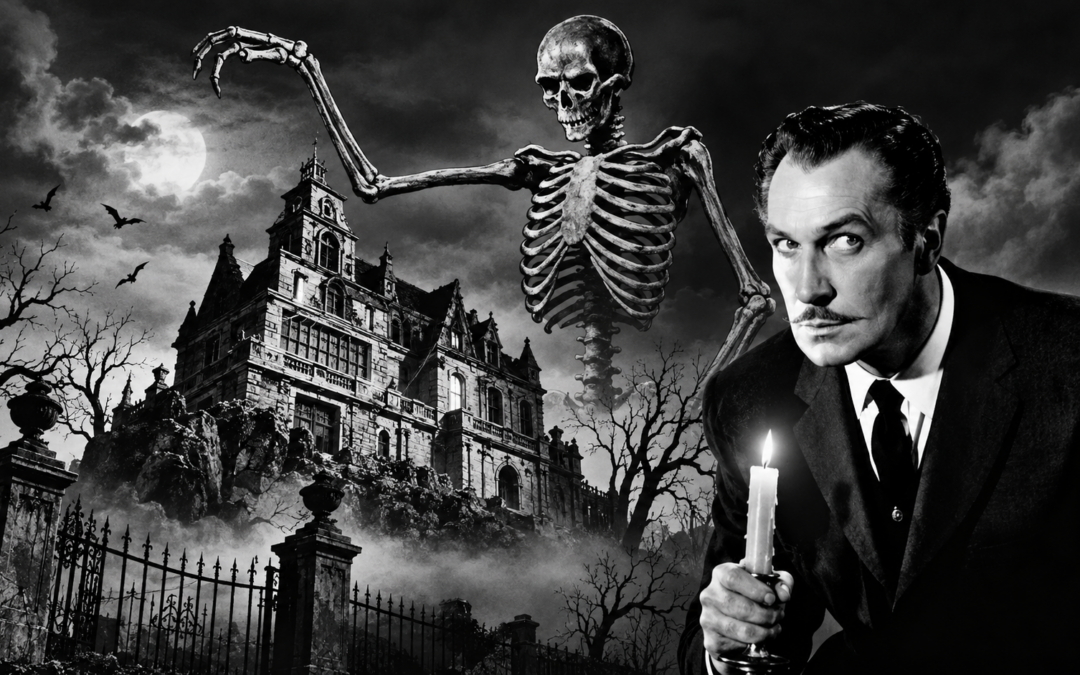
As Halloween approaches, I decided to revisit a classic horror film from Hollywood’s golden age: 1959’s The House on Haunted Hill. Written by Robb White and directed by William Castle, The House on Haunted Hill stars horror icon Vincent Price, with strong supporting roles from Carol Ohlmart, Richard Long, and Elijah Cook, all well-known performers of the 40s and 50s.
Why Horror?
Before we delve into the film itself, let’s address a more fundamental question: as Catholic homeschoolers, what’s the benefit of watching horror? I totally get this concern. And to be sure, contemporary horror—with its focus on visceral jump-scares and grotesque body horror—has few redeeming qualities for Christian audiences.

Yet while we may justly critique modern horror’s excesses, there are valuable reasons to selectively dabble in this genre. Horror as a genre began long before television and movies, in 19th-century novels. Some of the greatest literary works in the English language come from the genre of Gothic horror. This genre combines an atmosphere of mystery, terror, and the supernatural with dark themes of decay, guilt, and human folly. Mary Shelley’s Frankenstein, Bram Stoker’s Dracula, and Robert Louis Stevenson’s The Strange Case of Dr. Jekyll and Mr. Hyde are the most notable among 19th-century novels. For short stories, we could of course reference Edgar Allen Poe, Charles Dickens, and even some of the works of Nathaniel Hawthorne (for example, “Young Goodman Brown”).
What Classic Horror Teaches Us About Human Nature
These classic tales use dark imagery and supernatural terror as mirrors from which we can discern the darkness of which human nature is capable. Hawthorne’s “Young Goodman Brown,” for example, tells the story of an ostensibly devout Puritan town in New England. Yet, everyone, from the women to the minister, is secretly involved in witchcraft. The moral of the story is that everyone carries hidden sin and hypocrisy. Obsessing over the universal flaws of humanity leads to total cynicism, isolation, and ultimately, spiritual death. This level of insight is precisely why Shelly, Hawthorne, Poe, and the others are still studied today within Catholic literary curricula.
Flannery O’Connor and the Power of the Grotesque
Among 20th-century Catholic authors, we cannot overlook the great Flannery O’Connor. Her unique Southern Gothic style was populated by what she called “the grotesque”—physical “freaks”, people with disabilities, or deeply flawed individuals whose outward oddities reflect a twisted inner or moral state. O’Connor’s Catholic audiences sometimes complained about her use of these troubling characters. But O’Connor maintained that she had recourse to the grotesque to pierce the spiritual blindness of a numb or hostile modern audience. In her 1969 essay “Mystery and Manners,” O’Connor famously stated:
“When you can assume that your audience holds the same beliefs you do, you can relax a little and use more normal means of talking to it; when you have to assume that it does not, then you have to make your vision apparent by shock — to the hard of hearing you shout, and for the almost-blind you draw large and startling figures.”
Thus is the true value of horror: the emphasis on the dark, the frightening, the grotesque jars us into contemplation of challenging truths we are ordinarily too intellectually lethargic to confront.
The House on Haunted Hill (1959): Plot and Review
Which brings us to The House on Haunted Hill. An eccentric millionaire Frederick Loren (Vincent Price) and his wife Annabelle (Carol Ohlmart) throw a party in a haunted house and offer the guests $10,000 if they will stay through the night. The house has been the scene of multiple murders over the years and is believed to be infested with malevolent spirits. The guests come from all walks of life but are deliberately chosen for one commonality: they are all in dire financial straits and need the $10,000.
Anyone who wishes to leave may do so before midnight. After that, the doors will be locked, and all remaining guests must stay through the night. There is no guarantee that they will survive.
At first, the guests are skeptical, but then strange events begin occurring. Doors randomly slam and lock, a chandelier falls, and bizarre spectres are seen gliding to and fro. But are these truly supernatural manifestations, or is human deception behind them? As the clock winds down and the guests grow increasingly paranoid, suspicion centers on the mysterious Mr. Loren and his wife, Annabelle. They clearly know more than they let on. But what are they up to, and why is the macabre game happening in the first place?
That’s about all the plot I want to give away. However, I can tell you that The House on Haunted Hill blends horror with a whodunnit murder mystery. It keeps the viewer’s mind constantly engaged as they try to piece everything together. Overall, it’s a solid story. Even though many of the effects are schlocky and dated by today’s standards, the overall atmosphere still holds up. A few loose ends in the plot don’t quite line up, but they don’t detract from the film’s enjoyability.
Greed Consumes Itself
Like the other horror classics I mentioned, The House on Haunted Hill mirrors the destructive power of human vice. In this case, the lesson is that greed and murderous betrayal ultimately destroy the people who plot them. We can debate whether supernatural entities like ghosts exist, but ultimately, human beings are the real monsters we have to worry about.
I really enjoyed the film, and it was cool to see how horror was handled in an era of primitive special effects and low budgets. The film was a commercial success and went on to inspire none other than the great Alfred Hitchcock. He became convinced of the viability of low-budget horror and went on to make his classic Psycho as a result. And though he is not the protagonist,
Vincent Price absolutely dominates the film with his characteristically creepy presence and delivery. He leaves you in a constant state of unease. Until the very end, you are never quite sure if you can trust his Frederick Loren, simply because Price himself maintains such an unsettling demeanor.
A Halloween Movie Worth Watching with Older Kids
If you’re looking for something spooky to watch with your older kids this Halloween, The House on Haunted Hill is a great pick. It’s fun, a little scary, and free of the gore that plagues so much modern horror. Like the Gothic classics before it, it holds a dark mirror up to human nature. It also gives you a perfect opening to talk with your kids about where greed and betrayal ultimately lead. As Flannery O’Connor understood, sometimes a good scare is exactly what we need to wake up to truths we’d otherwise be numb to thinking about.
What are your thoughts on this topic? I invite you to join other homeschooling parents and me in the Homeschool Connections Community or our Facebook group.
Editior’s Note: Homeschool Connections offers online courses for the following Gothic horro novels:
- Gothic Book Club with Eleanor Nicholson
- Dracula by Bram Stoker (1897) with Eleanor Nicholson (Victorian Classics)
- Frankenstein: Misunderstood Monster with Joseph Pearce
- Monsters of Romanticism: Frankenstein and Dr. Jekyll & Mr. Hyde with Henry Russell, PhD