Understanding Mormonism: Principles, History, and Catholic Insights
This is the thirteenth article in a series. To learn more, see: “The -Isms Encyclopedia: Historical and Philosophical Ideas Explained” by Mr. Phillip Campbell.
In June 2026, the Pentagon made news by removing the designation “Christian” from the Church of Jesus Christ of Latter-day Saints (i.e., Mormons) and listing it as a distinct religious group. This meant that, from the federal government’s point of view, Mormons were no longer considered Christians.
The Pentagon faced massive backlash for this reclassification, ultimately solving the matter by removing the “Christian” label from all churches, treating each as its own distinct religious entity. The controversy thrust Mormonism into the national spotlight and prompted impassioned discussions about what Mormons believe and whether they can be considered truly Christian. We shall explore the fundamentals of Mormonism in today’s installment of the -isms encyclopedia.

Many of us have had the experience: a knock at the door on a Saturday morning, and there on the porch stand two clean-cut young men in white shirts and ties, black name tags identifying them as “Elder” So-and-So of The Church of Jesus Christ of Latter-day Saints. Mormonism is one of the few major religions to have been born on American soil, and it remains one of the most visible. With roughly seventeen million members worldwide (more than half of them now outside the United States) and one of the most vigorous missionary programs of any religious body on earth, the Latter-day Saints are a faith Catholics are bound to encounter.
Mormonism presents a unique challenge for Catholics. Unlike Buddhism or Stoicism, which come to us from outside the Christian tradition entirely, Mormonism uses the vocabulary of Christianity (Jesus Christ, baptism, apostles, priesthood, revelation) while investing these words with meanings profoundly different from those of historic Christianity. It is precisely this apparent familiarity that can make Mormonism confusing. It is thus important for Catholics to understand what the Latter-day Saints actually believe, where their movement came from, and how the Catholic Church has assessed its claims.
Joseph Smith
Any discussion of Mormonism must begin with its enigmatic founder, Joseph Smith. Smith was born on December 23, 1805, in Sharon, Vermont. He was the son of a poor farming family that eventually settled near Palmyra in western New York. This region was so repeatedly swept by waves of revivalism in the early nineteenth century that historians call it the “Burned-Over District.” Competing preachers vied for converts, and the young Smith later recalled being deeply troubled by the question of which church was true.
He was told by two separate individuals that all existing churches were in error and that he should join none of them. According to Smith’s own account, in the spring of 1820, when he was fourteen years old, he retired to the woods to pray about this question. There he is said to have received a vision of God the Father and Jesus Christ. Latter-day Saints call this the “First Vision,” and it stands at the foundation of their faith.
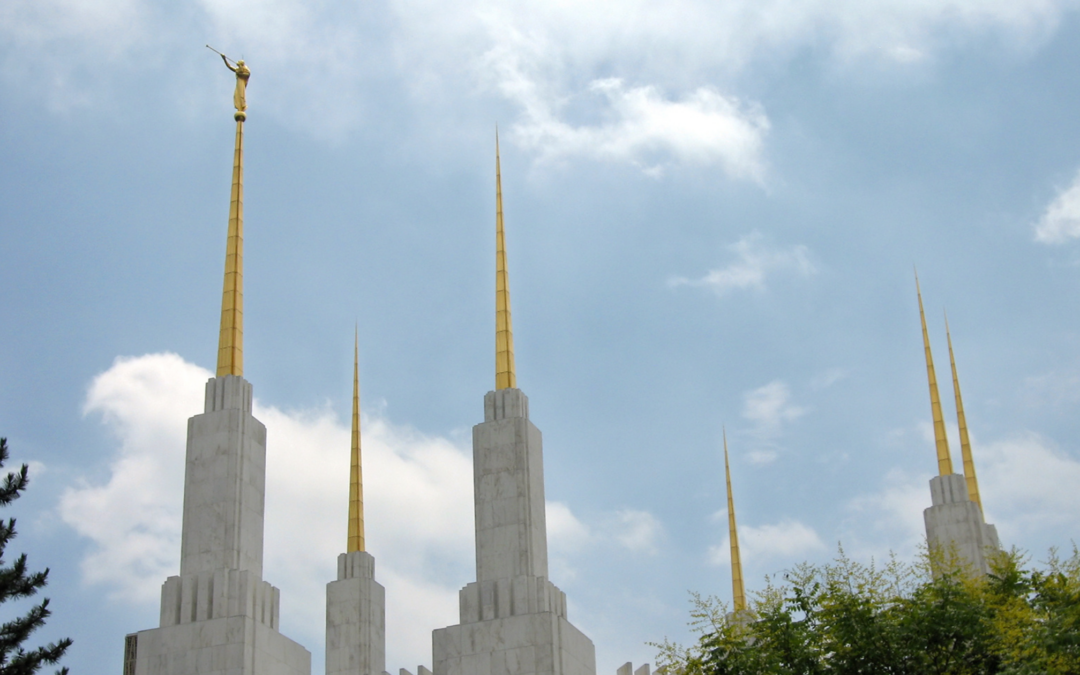
The Angel Moroni
Smith further related that in 1823 an angel named Moroni appeared to him and revealed the location of a set of golden plates buried in a hillside near his home, inscribed with the record of an ancient people. Smith said he received the plates in 1827 and translated them by the gift and power of God. The result was published in 1830 as the Book of Mormon, which purports to be a religious history of Israelite peoples who migrated to the Americas around 600 BC and were visited by the risen Christ.
On April 6, 1830, in Fayette, New York, Smith formally organized what he called the Church of Christ (later renamed The Church of Jesus Christ of Latter-day Saints). He presented himself as a prophet through whom God was restoring the true Church to the earth. Over the following fourteen years, Smith led his growing flock westward, first to Kirtland, Ohio, then Missouri; and finally to Nauvoo, Illinois. He produced further revelations and scriptures along the way and developed an increasingly distinctive theology.
Polygamy
Among Smith’s most controversial innovations was plural marriage—the practice of a man taking multiple wives—which Smith claimed had been commanded by God as part of the restoration of the ways of the ancient patriarchs, and which he introduced secretly among his most trusted followers while publicly denying it.
It was this issue that would end his life. In 1844, after Smith ordered the destruction of a dissenting newspaper that had exposed his practice of plural marriage, he was arrested and jailed in Carthage, Illinois. Then on June 27, a mob stormed the jail and shot him and his brother Hyrum to death. To Latter-day Saints, he died a martyr; to his critics, he was a religious impostor whose movement had grown beyond his control.
Principles of Mormonism
Mormon theology developed over the course of Smith’s prophetic career and continued to develop after his death, since Latter-day Saints believe in continuing revelation through living prophets. Still, we can identify the essential principles that define the faith:
The Great Apostasy and Restoration
The foundational claim of Mormonism is that the Church established by Jesus Christ fell into total apostasy shortly after the death of the apostles. According to Latter-day Saint teaching, the priestly authority Christ gave to His apostles was lost from the earth. The true doctrines were then corrupted, and for some eighteen centuries no church on earth possessed divine authority.
Mormonism therefore presents itself as a restoration: through Joseph Smith, God restored the priesthood (Smith claimed to have received the Aaronic priesthood from John the Baptist and the Melchizedek priesthood from Peter, James, and John, all appearing as heavenly messengers), the true doctrine, and the organizational structure of the primitive Church, complete with apostles and prophets. Every other Mormon claim rests on this one.
Continuing Revelation and New Scripture
Latter-day Saints accept the Bible as scripture “as far as it is translated correctly.” However, they added three additional volumes:
- The Book of Mormon (It is from this book that members came to be nicknamed “Mormons,” after the ancient prophet said to have compiled the record).
- The Doctrine and Covenants (a collection of Smith’s revelations),
- And the Pearl of Great Price.
Moreover, they hold that revelation did not cease with the apostles nor even with Smith. The president of the church is regarded as a living prophet who can receive binding revelation for the whole church, and doctrine can therefore develop or change in ways that would be impossible in historic Christianity.
The Nature of God
Here Mormonism departs most dramatically from the historic Christian creeds. Mormons reject the doctrine of the Trinity. In its place, they teach that the Father, the Son, and the Holy Spirit are three separate beings, united in purpose but not in substance. More striking still, Mormon teaching holds that God the Father possesses a glorified body of flesh and bones, and that He was not always God.
In his famous King Follett discourse of 1844, Smith taught that God was once a man who progressed to godhood, and that human beings may do the same. The fifth president of the church, Lorenzo Snow, summarized the doctrine in a famous couplet: “As man now is, God once was; as God now is, man may become.” Mormonism thus teaches a doctrine of “eternal progression” in which godhood itself is the destiny of the faithful; a faithful Mormon expects to become a god in the next life.
The Plan of Salvation
Mormons teach that all human souls existed before birth as spirit children of heavenly parents, that mortal life is a probationary period in which we gain a body and are tested, and that after death nearly all people will inherit one of three “kingdoms of glory”—the celestial, terrestrial, or telestial. The highest state, called exaltation, is reserved for faithful Latter-day Saints who have received the “ordinances of the temple,” including baptism, endowment (a type of Mormon confirmation), and eternal marriage (“sealing”). Because these ordinances are considered necessary, Latter-day Saints also perform them vicariously on behalf of the dead; hence the famous Mormon devotion to genealogical research and the practice of baptism for the dead.
The Mormon Way of Life
Whatever one makes of Mormon doctrine, the Latter-day Saint way of life is famously disciplined. Members abstain from alcohol, tobacco, coffee, and tea in obedience to a health code called the Word of Wisdom. They tithe ten percent of their income, fast monthly, observe strict standards of chastity, and place enormous emphasis on marriage and family life. Young men (and increasingly young women) devote roughly two years to full-time missionary service at their own expense, which is why those young elders keep appearing on our doorsteps.
Who’s Who of Mormonism
Mormonism’s story is inseparable from the personalities who shaped it. Here are a few figures every student of the movement should know:
Joseph Smith, Jr. (1805–1844)
The founding prophet, discussed above. Whatever one concludes about his claims, Smith was one of the most remarkable religious figures America has produced: in a career of just fourteen years he dictated a book of scripture longer than the New Testament, founded a church, built cities, commanded a militia, ran for president of the United States, and died at the hands of a mob at age thirty-eight. Mormonism bears the stamp of his character and ideas even to this day.
Oliver Cowdery (1806–1850)
A schoolteacher who served as Smith’s principal scribe during the translation of the Book of Mormon. He was with him, Smith said, when the priesthood was restored by heavenly messengers. Cowdery was one of the “Three Witnesses” who testified to having seen the golden plates. He was excommunicated in 1838 after a falling-out with Smith, though he rejoined the church shortly before his death.
Brigham Young (1801–1877)
A Vermont-born carpenter and early convert who rose to become the senior apostle and, after Smith’s death, the second president of the church. Sometimes called the “American Moses,” Young led the Mormon exodus to the Great Basin, directed the colonization of the American West, served as Utah’s first territorial governor, and publicly established the practice of plural marriage (he himself had some fifty-five wives). More than anyone else, Young transformed Mormonism from a persecuted sect into a durable people.
Wilford Woodruff (1807–1898)
The fourth president of the church and one of its most zealous early missionaries. Woodruff is remembered chiefly for the 1890 Manifesto, which officially ended plural marriage and made peace with the United States government possible. The 1890 Manifesto is a prime example of how continuing revelation allows Mormon doctrine and practice to change.
Spencer W. Kimball (1895–1985)
The twelfth president of the church, who in 1978 announced the revelation extending the priesthood to men of all races, which until 1978 had deliberately excluded blacks. Kimball’s presidency also saw enormous international expansion, setting the stage for the global church of today.
The History of Mormonism Post Smith
After Smith’s murder in 1844, the movement fractured. The largest body of Mormons followed Brigham Young. Young was the senior apostle, who in 1846–47 led one of the great migrations of American history. It was an exodus of thousands of Mormon pioneers across the plains to the valley of the Great Salt Lake, then beyond the borders of the United States. There, in the Utah desert, Young built a theocracy, directing the founding of hundreds of settlements across the American West and serving as territorial governor.
Smaller groups followed other claimants to Smith’s mantle. The most significant was the Reorganized Church of Jesus Christ of Latter Day Saints (today called the Community of Christ), led by Smith’s own son.
Crisis and Secrecy
The great crisis of nineteenth-century Mormonism was polygamy. Smith had secretly introduced the practice of plural marriage in Nauvoo, and under Young it was publicly proclaimed and widely practiced. This put the Latter-day Saints on a collision course with the United States government, which spent decades legislating against polygamy, disincorporating the church, and jailing its leaders.
Tensions ran so high that in 1857–58 the federal government actually dispatched an army to Utah. The standoff ended only in 1890, when church president Wilford Woodruff issued the Manifesto officially ending the practice of plural marriage. Utah was granted statehood in 1896, and the church began its long transformation from a persecuted frontier sect into a respected pillar of American life. (Fundamentalist splinter groups that continue polygamy today are not affiliated with the mainline church, which excommunicates polygamists.)
The twentieth century saw the Mormons move steadily into the American mainstream. They emphasized patriotism, family values, business success, and wholesome living, while also expanding aggressively abroad. In 1978, church president Spencer W. Kimball announced a revelation extending the priesthood to men of all races, removing a longstanding restriction on members of African descent. Today the church claims some seventeen million members, operates hundreds of temples worldwide, sends out tens of thousands of missionaries, and possesses enormous financial resources. From a movement of a few dozen believers in upstate New York, Mormonism has become the most successful new religion of the modern era.
From a Catholic Perspective
Catholics and Latter-day Saints find themselves allies on many practical fronts, and this should be acknowledged with gratitude. Mormons take marriage, family, and children with a seriousness that puts much of the modern world to shame. They defend the sanctity of life, practice impressive works of charity and disaster relief, champion religious liberty, and cultivate personal virtues such as sobriety, chastity, thrift, and industriousness. In the public square, Catholics and Mormons have frequently stood shoulder to shoulder. Many Mormons are zealous advocates of homeschooling. On the level of lived morality, a devout Mormon family and a devout Catholic family will recognize much of themselves in one another.
Doctrinally, however, the divergence is about as deep as it can be. As mentioned in our intro, it is often asked whether Mormonism can even be considered Christian at all. The Catholic Church has actually given a formal answer.
Christian Baptism
In 2001, the Congregation for the Doctrine of the Faith, with the approval of Pope St. John Paul II, ruled that baptism conferred by the Latter-day Saints is invalid. This means a Mormon converting to Catholicism must be baptized absolutely, as one coming to Christianity for the first time. This is a remarkable judgment when one considers that the Church accepts the baptisms of Protestants, Orthodox, and virtually every other body that baptizes with water in the name of the Father, the Son, and the Holy Spirit. The reason is that the Mormon understanding of the Father, Son, and Holy Spirit differs so radically from the Christian faith that the same words no longer signify the same realities. Mormonism, in the Church’s judgment, is a new religion that emerged out of Christianity, rather than a branch of it.
Understanding of the Trinity
At the heart of the matter is the doctrine of God. Catholic Christianity, following Scripture, confesses one God, eternal and unchangeable, the Creator of all things from nothing: “I am the First, and I am the Last; besides me there is no god” (Is. 44:6). The Trinity is one God in three Persons, a single divine nature. Mormonism teaches instead a plurality of gods, of whom the Father, Son, and Holy Ghost are three; a God who has a body and who was once a man; and a cosmos in which matter is eternal, and God organizes rather than creates. Where the Christian God is the infinite source of all being, the Mormon God is an exalted being within the universe. Between these two conceptions there is no middle ground; they are mutually exclusive.
Apostolic Succession
The Mormon claim of a total apostasy also deserves attention, because it strikes directly at the Catholic Church. If the Church utterly lost the faith and the priesthood shortly after the apostles, then Christ’s promises failed: “the gates of hell shall not prevail against it” (Matt. 16:18), and “lo, I am with you always, even unto the end of the world” (Matt. 28:20).
Catholics can point to an unbroken, historically documented succession of bishops from the apostles to the present day, and to a deposit of faith guarded and handed on through every century. The historical record of the early Church’s life is abundantly preserved, and it looks like Catholicism, not like Mormonism. There is likewise no archaeological, linguistic, or genetic evidence for the ancient Israelite civilizations in the Americas described by the Book of Mormon, a difficulty acknowledged even by some Mormon scholars. The Catholic responding to the missionary’s claims should ask the simple historical question: did the apostolic Church actually disappear? Everything in the record says it did not.
Public Revelation
Finally, there is the question of continuing revelation. Catholics believe that public revelation closed with the death of the last apostle; the Church’s task ever since has been to guard, penetrate, and proclaim that deposit, never to add to it (CCC 66). Mormonism’s open canon and living prophets mean that its doctrine can be revised by new revelation, as happened with polygamy in 1890 and the priesthood in 1978. Whatever pastoral flexibility this provides, it leaves the believer without a fixed rule of faith. The Catholic, by contrast, stands on the faith “once for all delivered to the saints” (Jude 3), developed in understanding over time but never contradicted.
Continuing the Discussion
Homeschool Connections offers an apologetics course that goes deep into Mormonism. They also offer a world religions course that examines other faiths, including Mormonism, from a Catholic perspective:
- Pseudo-Christian Apologetics: Mormonism with Gary Michuta for 8th to 12th grade (8 weeks)
- World Religions with Christopher Martin, PhD, for 7th to 12th grade (8 weeks)
Note that while adults cannot take the LIVE interactive courses, they are welcome to take the self-paced recorded versions through Unlimited or Single Access programs.
Final Thoughts
The next time the young elders appear at your door, remember that you are meeting people of sincere faith and admirable discipline, but also representatives of a theology that has redefined the very meaning of the word “God.” Charity requires that we treat Latter-day Saints with respect and recognize the genuine goods in their way of life. Truth requires that we understand how far their doctrine stands from the faith of the apostles.
A Catholic well-formed in the history of the early Church, the doctrine of the Trinity, and the meaning of apostolic succession has nothing to fear from these conversations; indeed, he may find it a providential opportunity. For everything the Mormon restoration promises has been present all along, preserved through twenty centuries in the Church that Christ founded and never abandoned.
What are your thoughts on this topic? Join other homeschooling parents and me in the Homeschool Connections Facebook Group or in the HSC Community to continue the conversation.