
Screens, Slouching, and Spine Health: Posture Problems in the Modern Teen
Common Teen Postural Problems
Human beings were clearly designed by our Creator to stand upright. Our anatomy is structured to support upright posture and bipedal walking. For example, our pelvis and legs are structured to keep our trunk balanced atop our bodies during movement and reduce side-to-side swaying. As only one leg contacts the ground at a time while walking, maintaining balance is crucial.
The structure of the human foot is another great example. Our feet are stiff for a better push-off, not flexible like the feet of climbing apes. While our big toes are not opposable, and we can’t really grab things with our feet, we can bear weight more comfortably and effectively. In other words, our feet were made for walking.

So what happens when we take these bodies that were clearly designed for upright movement and stuff them into chairs, looking at screens for most of the day? What happens when the skull—which is designed to balance atop the spinal column oriented straight ahead—is tilted downward, looking at a phone for hours?
In this article, we will discuss common postural deviations related to sedentary lifestyles that parents should watch for—both in their kids and in themselves! Then we will discuss remedies for these posture problems in a follow-up article.
Three Common Postural Deviations
People who spend prolonged periods in certain positions, such as sitting or looking down, often develop postural deviations. A postural deviation is an abnormal alignment of the body’s joints and structures, resulting from poor posture. Beyond looking aesthetically unattractive, postural deviations can also lead to discomfort, pain, and, in some cases, even impaired movement.
The sedentary nature of modern life is making postural deviations due to prolonged sitting and phone use regrettably more common. If you’ve ever had to tell your child to “Stop slouching!” or “Stop looking down!” you’re likely already dealing with some of these issues. If these deviations are not corrected during youth, then they can lead to more serious problems later in life. Therefore, it’s important to identify and correct them early on.
But what is going on anatomically if your teen is “slouching” or hunched over, and how can you identify if your teen has a real postural deviation, as opposed to just…walking around lazily because they’re a teenager?
There are several types of deviations common with teens who spend too much time sitting or looking down at a device. These include:
Forward Head Posture/Rounded Shoulders
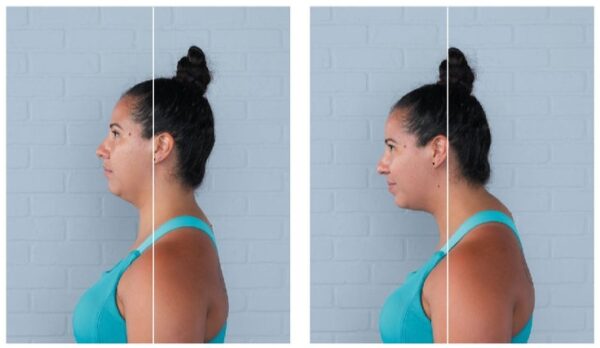
The head juts forward from the shoulders, placing extra strain on the neck. This is often accompanied by rounded shoulders. The head might not necessarily be tilted downward, but simply shifts forward. A good rule of thumb to tell if someone has forward-head posture is to look at the front of the ear. In a normal posture, the front of the ear should be aligned with the AC joint at the front of the shoulder. If it protrudes beyond this, you are dealing with forwardhead posture. In the image below, a normal aligned head posture (left) is contrasted with a forward-head posture (right). Notice the alignment of the ear:
Kyphosis (“Hunchback”)
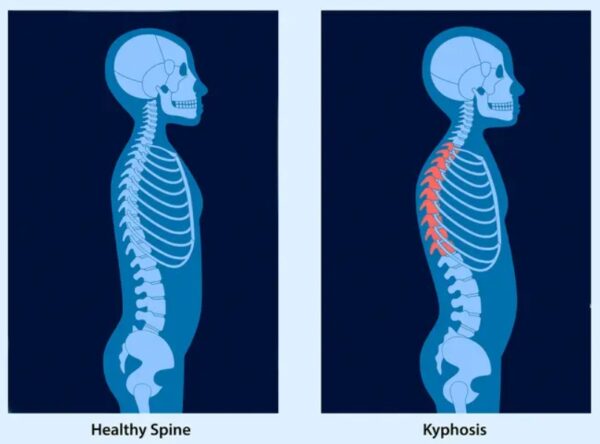
Prolonged periods of sitting without proper back support can result in increased curvature of the thoracic (upper) spine. This is a condition known as postural kyphosis, or a “hunchback” in common parlance. The condition develops from continuously slouching and hunching over a screen, which weakens certain muscles while tightening others, causing an excessive forward curvature of the upper back.
Teens who spend hours each day gaming are at particular risk for this deviation. (It is important to note that there are different types of kyphosis; postural kyphosis is due to poor posture and correctible, while other types of severe kyphosis can be caused by chronic spinal conditions and require more intensive interventions. We are here only discussing postural kyphosis.) Usually, it is easy to tell at a glance if someone has a kyphotic posture because they will appear to be slouching forward.
Here is a diagram comparing a kyphotic posture to a normal upright posture:
Lordosis (“Saddleback”)
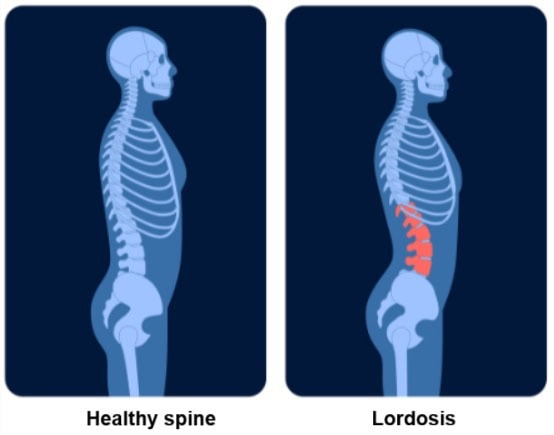
While kyphosis is a posterior curvature of the upper spine, lordosis (also known as “saddle back” or “hollow back”) is the increased anterior (forward) curve of the lower spine, creating a “C” shape in the spine. Prolonged sitting can contribute to lordosis by causing poor posture that leads to excessive inward curvature of the spine.
This happens because sitting can tighten the lower back muscles that keep the spine straight, while a sedentary lifestyle can weaken the core muscles that support the spine. It is essentially an inability of the lower back muscles to maintain an erect posture. Here is a diagram comparing a healthy spine to a lordotic posture:
When Should You Be Concerned?
We all have bad posture occasionally. All of us slouch now and then. All of us let our heads droop or let loose a bit when we feel groggy or dejected. If you see your teen with bad posture, how do you know whether he has a postural deviation or is just feeling a little slouchy that day?
Obviously, a postural deviation is more enduring. It won’t come and go just because your teen is having a bad day. A real postural deviation will be discernible most of the time. A good rule of thumb, though, is to ask your teen to stand at ease without telling them why. Just ask them to stand as they normally would and take a look at their posture. If you notice the postural problem when they are at rest and not cognizant that they are being evaluated, chances are you’re dealing with a postural deviation.
The good news is that these common postural deviations can be corrected with some stretches, muscle strengthening, and a few lifestyle changes. We will talk about remedying these postural deviations in our next article!
In Closing
The information provided in this article is for general educational and informational purposes only and is not intended as medical advice, diagnosis, or treatment. Every child’s body and health situation is unique. If you have concerns about your child’s posture, pain, or physical development, please consult your family physician or a qualified healthcare professional for personalized guidance.
What are your thoughts on this topic? I invite you to join other homeschooling parents and me in the Homeschool Connections Community or our Facebook group.