Save Your Soul: Read the Gothic
“Aren’t these books dangerous?” I regularly hear this question from Catholic students as I introduce them to the Gothic.
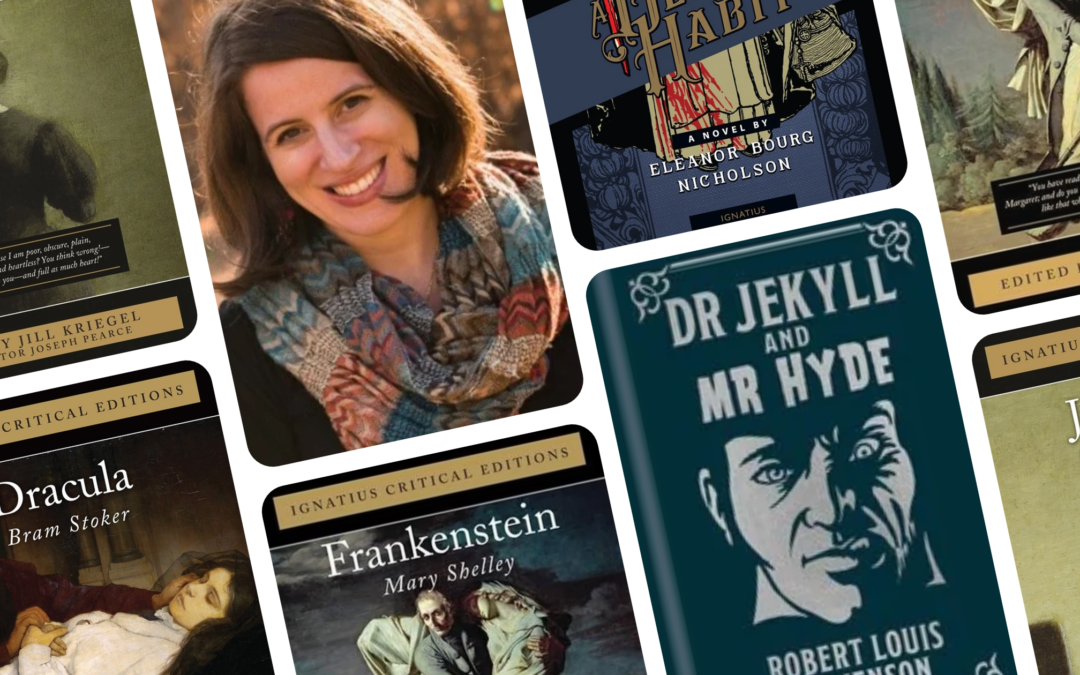
Raised to recoil from evil, they understandably eye with concern a genre that seems to speak of preternatural evil. And it’s not merely a question raised by high schoolers. When my first Gothic novel, A Bloody Habit, appeared in print, I received a truly memorable bit of readerly feedback when a homeschooling mother condemned me for corrupting youth through my “wicked” book—a startling accusation to receive about an Ignatius Press publication! I know similar reactions have come up around reading and teaching Bram Stoker’s Dracula, the first work I taught for Homeschool Connections nearly a decade ago.
Can Gothic literature be good for Catholic readers? Yes. When approached with maturity and discernment, classic Gothic literature can help readers confront questions of good and evil, sin, redemption, and the need for God’s grace.

Raising Discerning Readers
Concerns about this topic are rooted in the same source that prompts anxiety about Halloween. To address that loaded topic, I refer all readers to the excellent treatment provided by the historian Fr. Augustine Thompson, OP.
As a homeschooling mother and as a literature instructor, I am passionate about raising critical, intelligent, well-informed readers. I want my children and my students to be discerning: to take what is good in a book and value it, and to see what is imperfect or problematic in a book, weighing and judging it appropriately. This requires maturity and experience. It also requires a well-disciplined imagination, which directs us toward what we should read and what we should not.
Any genre can become a near occasion of sin. Romance novels can lapse into pornographic fantasies. Drawing room comedies can be stealthy, seductive advocates for amorality. Science fiction can be a vehicle for an atheistic creed. Gothic—or, more often, its illegitimate offspring of contemporary horror—can glorify evil. A discerning reader, especially guided by parents and trustworthy authorities, will seek the good and avoid the bad.
When Should Catholics Avoid Certain Books?
Sometimes the bad is obvious. For instance, when I accidentally received a box from a publisher containing witchcraft manuals rather than copies of one of my novels, Dr. Nicholson and I immediately contained the books and contacted the publisher. When the publisher told us to keep the books, we contacted a Dominican friar. Then, at his direction, we destroyed them. Once we knew what the books were, we did not look into them further, and did not permit our children to look at them. The children expressed both fear and nervous curiosity. Long conversations ensued, in which we explained the true dangers of the occult.
Other times, the danger is less obvious, and we need guidance. I recall a moment in graduate school. I was working to shore up my courage to read a novel by the French Decadent author Joris-Karl Huysmans. I mentioned this to Joseph Pearce, who mentored and befriended me during my university years. “Don’t read it,” he told me. He said it was too deep a look into the author’s struggles with the occult (which did eventually lead Huysmans to the Church), and that my serenity would be disrupted. It was humbling, but also a relief. I wanted to read expansively, but I respected Joseph’s counsel. It is, therefore, with discernment and readerly formation in mind that I encourage students—and their parents—to venture into the dark realm of the Gothic.
What is the Gothic?
The Gothic literary tradition emerged largely as a reaction against the (so-called) Age of Enlightenment (~1660-1790), also known as the Age of Reason. The Enlightenment was a period of political and philosophical revolution that influenced government, economics, religion, and education. Key developments included the modern scientific method, with an emphasis on scientific observation and pure reason; modern concepts of freedom; ideals for a “better world”; and egalitarianism. These led at the same time to rejection of established religion, Deism, skepticism, atheism, and materialism.
The Enlightenment’s emphasis on human reason and observable, quantifiable phenomena sparked a reaction. Much that was weird, wonderful, preternatural, and beyond the boundaries of the new science found its way into the pages of the Gothic. Because the Enlightenment can be traced back to both the secular humanism of the Renaissance and the theological confusion of the Reformation, it is perhaps not surprising to see a tormented relationship with Catholicism in the Gothic as well. The Gothic teems with sinister Catholic monks, severe nuns, and the accessories of Catholic ritual, particularly with regard to exorcism. (Readers who want to delve specifically into the Catholic/anti-Catholic side of the Gothic can read this article.)
What Are the Classic Works of Gothic Literature?
Scholars date the beginning of the Gothic literary tradition to Horace Walpole’s 1764 The Castle of Otranto. This bizarre, outrageous, thoroughly un-Enlightened novel captures many elements of classic Gothic: preternatural horrors never fully explained, mysterious old buildings, moldy manuscripts, melodramatic (and often superficial) characters, cultural stereotypes, dangerously bad weather, and swooning heroines inadequately informed and thus inadequately protected.
A host of works followed on both sides of the Atlantic—some fully Gothic, some next-door to Gothic. Major titles include:
- The Mysteries of Udolpho (1794) by Ann Radcliffe
- The Monk (1796) by Matthew Gregory Lewis
- Frankenstein (1818) by Mary Shelley
- Northanger Abbey (1818) by Jane Austen
- The Private Memoirs and Confessions of a Justified Sinner (1824) by James Hogg
- The Hunchback of Notre Dame (1831) by Victor Hugo
- Tales of the Grotesque and Arabesque (1839) by Edgar Allan Poe
- A Christmas Carol (1843) by Charles Dickens
- Jane Eyre (1847) by Charlotte Brontë
- Wuthering Heights (1847) by Emily Brontë
- The House of the Seven Gables (1851) by Nathaniel Hawthorne
- Strange Case of Dr. Jekyll and Mr. Hyde (1886) by Robert Louis Stevenson
- The Picture of Dorian Gray (1890) by Oscar Wilde
- Dracula (1897) by Bram Stoker
- The Turn of the Screw (1898) by Henry James
- The Hound of the Baskervilles (1901-2) by Arthur Conan Doyle
- The Phantom of the Opera (1910) by Gaston Leroux.
To some degree, these all continued the Gothic paradigm established by Walpole.
The Spiritual Depth of Monsters
Should we read these novels merely because they fall into the “classic fiction” category, or do they teach us something deeper? I believe I can best answer that question by apologizing for the genre’s continuation. While much of secular horror has decayed into nihilistic grotesquerie with little to defend in it, the classic tradition lives on in large part in the work of devout Catholic novelists. There are a number of authors who fall into this category, including Tim Powers, Karen Ullo, Andrew Seddon, and others, including me.
Personally, I write and teach Gothic fiction because it expresses reality’s moral and spiritual dimensions. I believe in monsters because I recognize the reality of sin. I live with myself; I am a monster in need of God’s grace. The heart of the best Gothic novels rests on the question of the protagonist’s redemption or damnation. The novel can often have a funhouse-mirror effect—as we gaze at the monster and recoil in horror, we are called upon to realize that much of ourselves lives in that horrifying creature.
In the Gothic, we can play with themes that would be absurd and preachy in another genre: life and death, salvation and damnation, morality and immorality. We can, in a healthy, mature way, address deep and even troubling questions, questions that life itself poses to us and will pose to our children.
What Can Gothic Literature Teach Us About Sin and Redemption?
We want our children to meditate upon Shelley’s Creature, Leroux’ Phantom, and Hugo’s Hunchback, and to know that they too are wretches in need of God’s grace. We want them to recognize the evil of Count Dracula as well as the perils into which Victor Frankenstein, Dr. Jekyll, and Dorian Gray stray. We want them to find inspiration in the heroic goodness of the anti-vampire band of Dracula and the moral growth in Ebenezer Scrooge. We want our children to recognize these works as a breed of literary memento mori.
We, like all these redeemed or doomed protagonists, will die and face Judgment. Finally, we want them to have the inoffensive delight of being thoroughly creeped out, described by Austen’s Henry Tilney in Northanger Abbey: “The Mysteries of Udolpho, when I had once begun it, I could not lay down again; I remember finishing it in two days—my hair standing on end the whole time.”
May the reading of these novels form us and provide innocent delights amid moral growth. Blessed All Hallows Eve, All Hallows, and All Souls Day to all our HSC families.
Homeschool Connections offers online courses addressing the Gothic (fully or indirectly):
- Gothic Book Club with Eleanor Nicholson
- Dracula by Bram Stoker (1897) with Eleanor Nicholson (Victorian Classics)
- Frankenstein: Misunderstood Monster with Joseph Pearce
- Monsters of Romanticism: Frankenstein and Dr. Jekyll & Mr. Hyde with Henry Russell, PhD
- British Literature after 1750 Part 1 (Classes 1-5 on the Enlightenment, Romanticism, and the Gothic) and Part 2 (Class 2 on Stevenson’s Dr. Jekyll and Mr. Hyde)
- Jane Eyre with Eleanor Nicholson
- Christmas with Dickens with Eleanor Nicholson
- The Brontë Sisters with Eleanor Nicholson
- The Sensation Novel with Eleanor Nicholson
- The Victorian Detective with Eleanor Nicholson
For more on Gothic horror, see Phillip Campbell’s article House on the Haunted Hill.
What are your thoughts on this topic? I invite you to join other homeschooling parents and me in the Homeschool Connections Community or our Facebook group.
NOTE: This article contains affiliate links.