Hybrid School vs. Homeschool Co-op: Is One Right for Your Family?
And What’s Working for My Family
As homeschooling continues to grow in popularity, families have more educational options than ever before. (Praise God!) Alongside traditional homeschooling, many parents are exploring homeschool co-ops and hybrid schools as a way to add community, support, and academic enrichment to their children’s education.
If you’re trying to decide between the two, you’re not alone. At first glance, co-ops and hybrid schools can appear remarkably similar. Both provide opportunities for children to learn alongside peers. Both offer experiences beyond what happens at home. And both can enrich a homeschool education and provide valuable support for parents. Yet beneath those similarities are two very different approaches to homeschooling. Understanding those differences can help you determine which option best fits your family’s goals, needs, and season of life.
What’s the Difference Between a Homeschool Co-op and a Hybrid School?
A homeschool co-op is typically a collaborative effort among homeschooling families. Parents are often very involved in organizing activities, teaching classes, coordinating events, and helping manage the group. Co-ops vary widely in structure. However, most function as a supplement to a family’s primary homeschool program rather than as the foundation. Parents may choose one subject to teach in the co-op and do everything involved from soup to nuts, meaning they research the topic, prep the materials for each week, and then teach the class.

A hybrid school operates differently. In a hybrid model, students attend classes taught by paid teachers for a portion of the week. Students then complete their remaining work at home. Depending on the program, students may attend classes one, two, or three days per week while homeschooling on the remaining days.
While both models blend home education with outside learning opportunities, the level of structure, accountability, and parental responsibility can be very different.
When a Co-op May Be the Better Choice
Many families are drawn to co-ops because they value flexibility, community, and lots of parent involvement.
Co-ops can also be ideal for parents who enjoy active involvement. Many thrive on teaching classes, organizing activities, or contributing their talents to a shared educational community. For these families, the collaborative nature of a co-op becomes one of its greatest strengths. Learning alongside your kids can be deeply connecting and a special opportunity to learn together in a group setting.
Additionally, co-ops often provide opportunities for enrichment that may be difficult to replicate at home. Science labs, public speaking classes, theater productions, art instruction, field trips, and group projects are common offerings that can add depth and variety to a homeschool education. Such classes allow a child to get an education in an area that their parent doesn’t consider a strength for them personally.
For families primarily seeking friendship, community, and enrichment, a co-op may provide exactly the level of support they need without sacrificing much flexibility.
When a Hybrid School May Be the Better Choice
Hybrid schools often appeal to families seeking more academic structure and support.
While parents remain actively involved in their children’s education, professional teachers typically assume responsibility for classroom instruction and lesson planning during class days. This can significantly reduce the pressure many homeschooling parents feel as their children progress into more advanced subjects.
Families approaching middle school or high school often find hybrid programs particularly attractive. Subjects such as advanced mathematics, laboratory sciences, formal writing, and foreign languages can feel intimidating to teach independently. A hybrid school can provide expertise in these areas while allowing parents to remain engaged in the educational process.
Hybrid schools may also benefit students who thrive with accountability outside the home. Some children simply perform better when they have multiple teachers, classroom expectations, and regular check-ins beyond their parents. The additional structure can create motivation and consistency without requiring full-time school attendance.
For families seeking a balance between homeschooling and traditional education, hybrid schools can offer a great middle ground.
Consider Your Family’s Current Season
One of the most important factors in this decision has little to do with academics and everything to do with your family’s current season of life.
A parent homeschooling multiple young children may have very different needs than a parent guiding a high school student toward graduation. Likewise, a family experiencing burnout may benefit from additional support that they would not have needed several years earlier.
Also to take into consideration is finances. Oftentimes, co-ops are free or low cost, especially if the parent volunteers. On the other hand, hybrid schools usually charge a fee to cover the cost of professional teachers. (Note that some states and communities offer reimbursement for homeschool costs.)
It is easy to fall into the trap of searching for a permanent solution. However, homeschooling rarely works that way. What serves your family well today may not be the best fit next year. The beauty of homeschooling lies in its adaptability. Families can make adjustments as their children grow, interests evolve, and circumstances change.
The Question Behind the Question
Many parents approach this decision by asking, “Which option is better?” In reality, that is rarely the most helpful question. A better question might be: “What problem am I trying to solve?”
If you are looking for friendships, enrichment opportunities, flexibility, and affordability, a co-op may be the answer.
On the other hand, if you are seeking rigorous academic support, increased structure, or help teaching advanced subjects, a hybrid school may be a better fit. In fact, if you feel overwhelmed carrying every aspect of your children’s education, a hybrid model may provide welcome relief.
And, lastly, if preserving complete control over curriculum and scheduling is your highest priority, a local co-op may offer the support you need without sacrificing independence.
The clearer you become about your family’s goals, the easier this decision becomes.
What’s Working for the Zara Family
For our family, a hybrid model has been a wonderful fit. My children are taught by other adults just two days each week, while I remain their primary teacher for the majority of their education. The program is closely aligned with our family’s values and educational philosophy, which was one of the most important factors in our decision.
One of the things I appreciate most about our hybrid is that it gives my children the opportunity to learn from people other than me. As much as I love homeschooling, I think there is tremendous value in children being exposed to different personalities, teaching styles, and expectations. Some teachers are more relaxed, some are more structured, and others simply explain concepts in a way that is different from how I would. I’ve watched my children grow in confidence and adaptability because of these experiences. I truly believe it has strengthened them as people.
Outside of the Hybrid or Co-op
In addition, we love to adventure out on the days we don’t have hybrid school. Some days it’s just the boys and me, sometimes we’re joined by extended family, and some days we join friends for field trips. The consistency of a hybrid school has created many meaningful friendships for my children. Since they see these peers twice a week, they have formed deep bonds, and we always have a friend to join us for a museum trip when we want to have a buddy join.
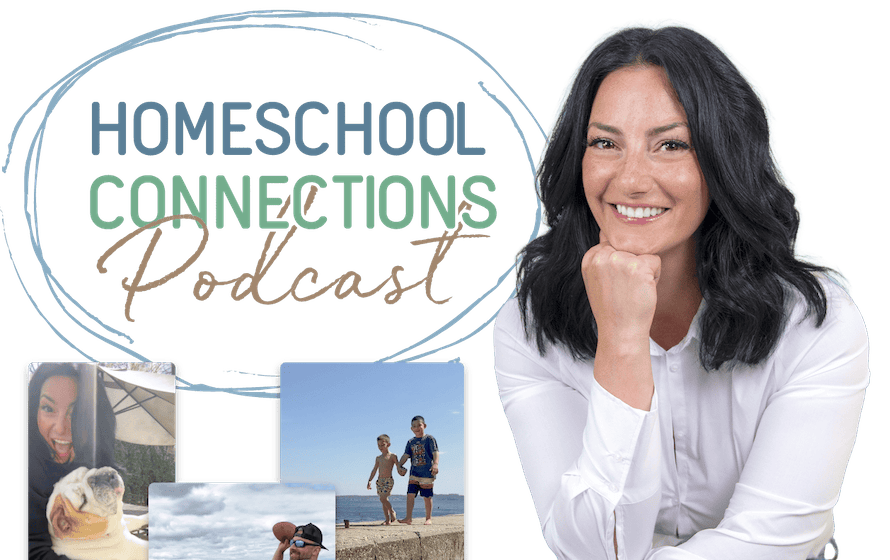
Another factor for our family is time. I am passionate about serving my family, and I also genuinely enjoy the work I do with the HSC podcast. At this stage of life, I have the capacity to thoughtfully plan and teach my children’s academics. However, I don’t have the extra margin to prepare lessons and teach classes at a co-op. The hybrid model provides support without adding those additional responsibilities.
For working parents, or parents balancing homeschooling with other commitments, a hybrid school can offer a level of flexibility that is incredibly helpful. It allows you to remain actively involved in your children’s education while sharing some of the teaching responsibilities with trusted educators. For our family, it has been a balance that works beautifully in this season of life.
There Is No One-Size-Fits-All Answer
One of the greatest strengths of homeschooling is that families are not limited to a single educational model. Some families participate in a co-op during the elementary years before transitioning to a hybrid school later. Others begin in a hybrid program and eventually return to a more traditional homeschool approach. Some combine elements of both, while others don’t choose either! There is no universally correct choice.
Whether that path leads you to a co-op, a hybrid school, or a completely independent homeschool experience, success is not determined by the model itself. It is determined by how well that model supports your family’s unique needs.
What are your thoughts on this topic? I invite you to join other homeschooling parents and me in the Homeschool Connections Community or our Facebook group.
Editor’s Note: Kaitlin Zara is a veteran educator, homeschool mom, and host of the Homeschool Connections Podcast. See her podcast episode on this topic here: