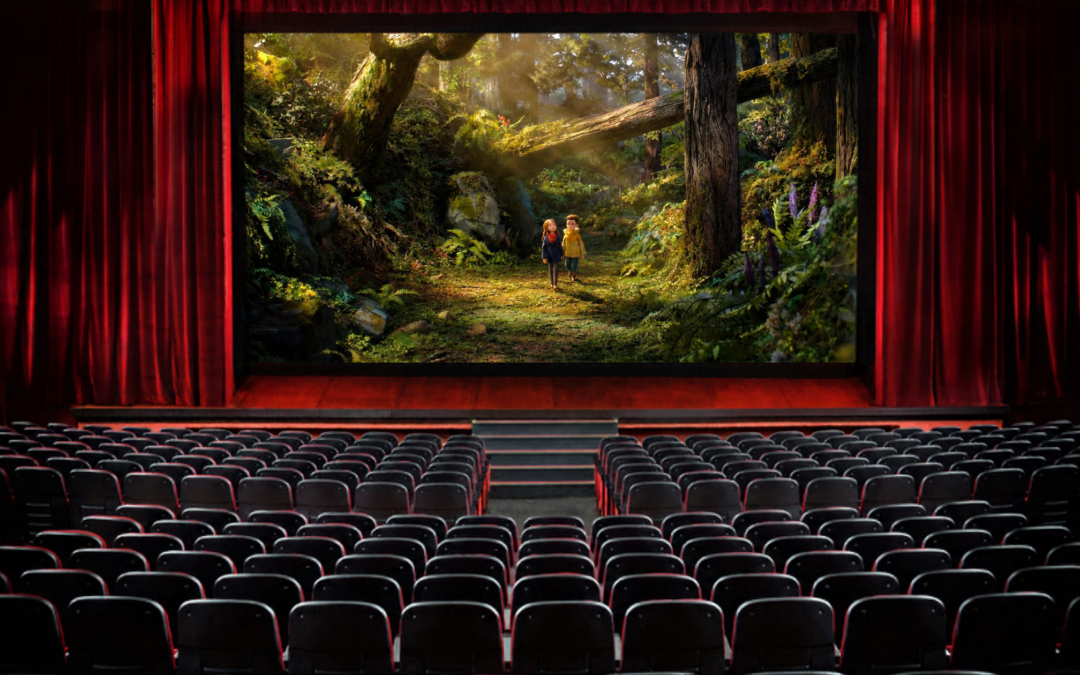
Movie Review: Wildwood (2026) — A Catholic Parent’s Perspective
I don’t go to the movies much anymore. This isn’t because I dislike the experience—on the contrary, going to the cinema is one of my most enjoyable pastimes. Honestly, I wish I could go more. But the sad fact is that Hollywood isn’t what it used to be. So much of what comes out today, in my opinion, is uninspired garbage. Too much of it is derivative franchise cash grabs and soulless CGI spectacle. The writing is bad, production is bad, and for some reason cinematographers have been putting ugly dark blue filters over everything. If I’ve stayed away from the theater, it’s because there is so little worth seeing.
This is why Wildwood caught my eye. In an age when CGI and AI rule the day, Wildwood was laboriously made in the old-fashioned stop-motion method. I am told that Laika Studios (Coraline, Boxtrolls, Kubo and the Two Strings) spent seven years on this project. I can see why; Wildwood has to be the most intricate and ambitious stop-motion film ever made. So I roused myself from my indifference and decided to give Wildwood a chance.
What Is Wildwood About?
Wildwood is based on a 2011 best-selling children’s novel of the same name by Colin Meloy. The film’s protagonist is teenage girl Prue McKeel. Prue lives in Portland, Oregon, with her crunchy uber-liberal parents and little brother, Mac. The McKeels are weirdly overprotective of Prue and her brother and seem afraid of everything. They are the sort of people who, a few years back, would have been quadruple-vaxxed and wearing three face shields. They are particularly insistent that Prue never under any circumstances go into the “Impassable Wilderness,” a vast and ancient forest on the other side of the Willamette River.

Prue eventually gets sick of her parents’ hyperprotectiveness. One day, when they are out, she decides to take her little brother Mac out for a day in Portland. They meet up with an obnoxious nerdy kid named Curtis who tries Prue’s (and the audience’s) patience with his shrill prattling. But things go awry when a group of sinister crows swoop into the park and literally carry Mac off into the Impassable Wood. Prue and Curtis follow them across the river and soon find that the Impassable Wood is a magical alternate reality. It is filled with talking animals, magical vines, bandits, witches, and all manner of fantastical creatures.
Prue will run in with a woman known as the Dowager Governess, who has vast swaths of the wood under her dominion. A mother bereaved of her own child, she seems compassionate to Prue and her plight. But are her offers of help sincere or part of an elaborate and devious ruse? The search for Mac will lead Prue and Curtis into a grand adventure upon which the entire fate of the wood hinges. In the process, Prue will learn some uncomfortable truths about her own family background.
What Wildwood Gets Right: Animation and Storytelling
It was the visual spectacle of Wildwood that first drew me to the theater. In this respect, I was not disappointed. We are well into the CGI era and at the dawn of the AI age, and after so many years of digital graphics, it’s refreshing to see real objects on screen. The figures of Wildwood are not clay; Laika used frame-by-frame puppet animation, each puppet supported by its own internal wire frame and moved by specialized mechanical rigs.
The production features 233 handcrafted puppets, 117 unique sets, and over 142,000 3D-printed replacement facial expressions that give the characters fluid, naturalistic movements. The level of intricacy is mind-boggling; for example, to simulate breathing, each puppet had an inflatable device inside to expand and contract the torso. The sets are insanely elaborate—there are scenes where hundreds of pieces must move simultaneously (the movie’s finale scene is quite extraordinary). I don’t say this much, but this movie was a pleasure to watch, just in a visual sense. The colors, the movement, and the composition were all brilliant. My eyes felt like they were getting treated to a 132-minute-long feast.
I would also like to mention the pacing and the way the writers gradually escalate the action and the stakes throughout. A lot of movies today fail in this regard, too often feeding us one action scene after another with little sense of plot progression or stakes. Wildwood knew how to turn the heat up gradually so that by the time we get to the climax at the end, it actually pays off because it feels earned.
Where Wildwood Falls Short: Character Development
I have never read the book, so I can’t speak to the source material. However, the movie left a bit to be desired in terms of the protagonist, Prue. The movie regrettably follows the common trope of the one-dimensional female protagonist. She has all the skills and resolve she needs right from the beginning. Yet, she doesn’t substantially grow or learn any valuable lessons. The one thing she should have assumed responsibility for—taking her brother out where he gets kidnapped—is revealed to not be her fault after all.
While she eventually warms to her annoying friend Curtis, it is because Curtis objectively becomes stronger and braver through his experiences, not because she has learned that it’s bad to judge people. Curtis, her parents, and even the villain have more interesting character arcs than Prue. Again, perhaps this is more sophisticated in the book, but I found her character to be a bit one-sided, the generic “Mary-Sue” so many people complain about these days.
Is Wildwood Too Violent for Children?
Wildwood is an animated film, but it does not mean that it is little kiddish. In fact, it deals with some pretty dark themes that involve sorcery, child sacrifice, grief, and disturbing family secrets. It is a movie that is not afraid of the macabre. The battle scenes were pretty intense—like, Braveheart-level intense. (In fact, I suspect the filmmakers studied Braveheart as a template for some of these amazing war sequences.) There is blood, and there is killing.
The melee battle scenes are brutal. We see someone get decapitated, a coyote-soldier get a sword through the eye socket, scores of people gunned down or slaughtered. We see people get incinerated by fireballs and a wounded prisoner run through with a saber while he begs for mercy. These scenes are just quick and bloodless enough for Wildwood to get a PG-13 rating instead of R, but they are intense nonetheless. I saw my ten-year-old daughter wince a few times. It’s not objectionable per se, but it is if you come in expecting a happy, kid-friendly Pixar movie. It’s not. It is a serious movie that deals with mature themes and features intense and realistic violence.
Sorcery and Spiritual Themes in Wildwood
Some parents online have also complained about the sorcery that plays such a major part in the film. The main antagonist practices Satanic necromancy. That’s not just my interpretation; one of the characters literally identifies the antagonist’s powers as “Satanic.” So like I said, it is dark. However, it is very, very clear that these powers are evil. There is no ambiguity about the darkness of the antagonist’s spiritual powers. The villain’s evil is countered, however, with a vague eco-spirituality centered on “listening to the trees” that is reminiscent of the James Cameron Avatar films. This is presented in a very innocuous and surface-level way, which is good because it means the film is not “preachy.” But from a story perspective, it becomes almost unbelievable that these docile tree listeners would have the fortitude to defeat the villain’s necromantic forces.
None of these things detracted from the enjoyment of the film for me, but they are things to be aware of.
Is Wildwood Worth Seeing? This Parent’s Perspective
Should you see Wildwood? If you care about things like the craft of filmmaking, the visual spectacle, practical effects, and just an entertaining theatrical experience, then absolutely. My kids and I all enjoyed it and found it a solid use of two hours. If, however, you are sensitive about things like intense battle scenes, or the scary dark spiritual powers of the villains, then maybe sit it out. If you do go, keep in mind it is much more suitable for older children, despite its cartoonish appearance. I’d say no children younger than 10 or 11, and that’s assuming they are not overly sensitive.
What are your thoughts on this topic? I invite you to join other homeschooling parents and me in the Homeschool Connections Community or our Facebook group.