Cooperative Board Games for Family Learning
Roll Call: All Hands on Deck!
Competitive games are a lot of fun. They help us learn important skills like planning ahead and handling losses positively. Still, most of us know that losing gracefully can be tough. Younger children can feel like older siblings or parents have a clear advantage. Friendly games can turn into sibling rivalry, with tears or slammed doors! I’ve heard this a lot: “I can’t play games with my children because they’re just way too competitive. It ends up being more stressful than positive!”
Enter cooperative board games! Cooperative board games are games in which players work together toward a shared objective rather than compete against one another. Everyone wins or loses as a team. The enemy is no longer your sibling. Instead, you form a united front against the board on the table.
Overall Cargo: Benefits of Cooperative Board Games
Can we gain as much from a cooperative game as we do from a competitive game? Absolutely! Cooperative board games are a valuable addition to gameschooling and can help children develop important skills such as:

- Adaptability
- Collaboration
- Communication
- Leadership
- Listening
Plus, all the usual things we get from nearly any board game: strategic planning, decision-making, critical thinking, and social-emotional learning.
Cooperative games don’t all ask players to work together in the same way. Let’s look at a few different ways teamwork can show up at the table.
Solve Together: EXIT
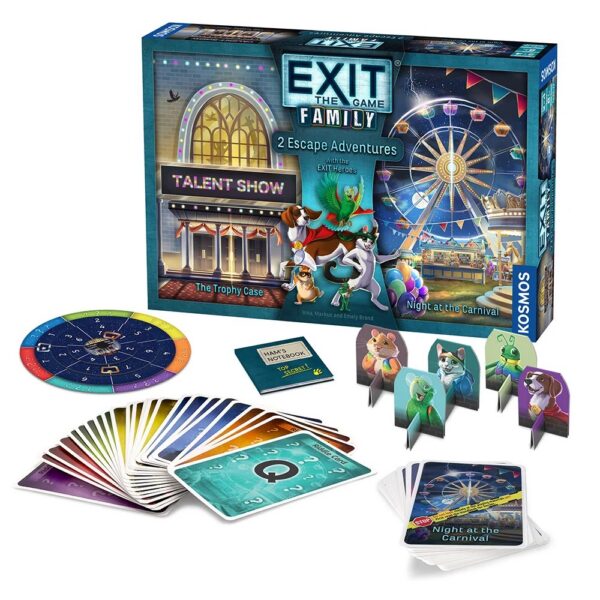
The EXIT line of games has grown into a whole family of cooperative puzzle games, with several Kids titles for younger players, Family editions that bridge the gap, dozens of standard EXIT adventures, and even a growing collection of Advent Calendars. KOSMOS often describes EXIT as an “escape room at home,” and that’s a good shorthand for the experience: cooperative puzzle-solving, riddles, hidden clues, and working together to move through an adventure. Their lineup includes:
- EXIT Kids — Designed for children ages five and up, these games can be played again and again. This newer series is a great introduction, challenging players with problem-solving, puzzles, and riddles. The Kids version relies on playful image riddles with no reading required. Independent children can even solve EXIT Kids solo!
- EXIT Family — The Family line bridges the gap between EXIT Kids and the standard EXIT: The Game line. Families join some clever animal superheroes as their sidekicks and work together to solve the case. The Family line plays extremely well to everyone’s strengths. If someone is more dexterous and better at balancing, they can complete tasks that might require standing on one foot. If another has a great eye for detail, they could be the one to find a hidden image. I can tell you firsthand that there were certainly times when my younger son was better at some of these tasks than I was! Everyone helps, even if it’s just two people holding an item or placing a sticker. It strikes a balance that entertains the whole family, young and old.
- EXIT: The Game — The original EXIT: The Game series; this one is great for older kids, teenagers, and adults. They have varying difficulty levels and themes for every mood, from Ancient Egypt to a science lab to castles to Middle-earth. These feel like bringing an escape room home, with immersive stories and puzzles that often make you look at the game components in unexpected ways. If your family enjoys working through a mystery together and slowly uncovering one clue after another, plenty of adventures are worth exploring.
- EXIT Advent Calendar — While my children love an Advent calendar, I have to admit I have never grown out of using one to count down to Christmas, either! At some point, though, I stopped being able to eat a piece of chocolate in the morning like my kids. The EXIT Advent Calendar gives you 24 riddles to solve, one each day, as you work your way through a mystery leading up to Christmas Eve. When the holidays can feel overly busy or overwhelming, this is a great way to pause and bring everyone together for a few minutes each day.
One of the most reassuring features across the EXIT line is the built-in hint system. If your group gets stuck on a puzzle, multiple levels of hints can nudge you in the right direction. You never have to worry that one impossible riddle will bring the entire adventure to a dead stop.
Plan Together: Pandemic
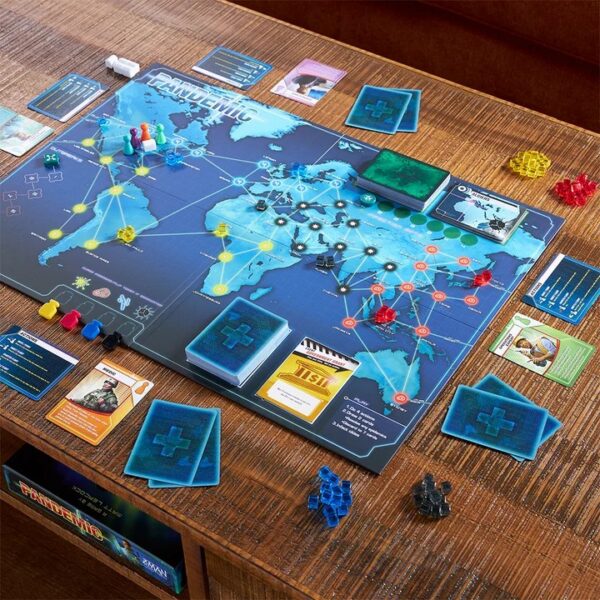
Before you panic with 2020 flashbacks, let me assure you that the game Pandemic came out years before 2020! The premise is a worldwide pandemic, and it’s up to you and your team to stop its spread and find the cures! The entire game board is a map of the world, and players juggle travel between continents, prioritize hot spots, and coordinate the best approach to creating cures.
This game is easy to find nearly anywhere. What makes Pandemic so great is that everyone has a different role. Communication is a must, and each player brings a different strength to the team. It provides a valuable lesson that every person can contribute in different ways. Players are constantly balancing priorities, evaluating risks, and deciding together where their limited actions will do the most good.
Communicate Without Words: Magic Maze
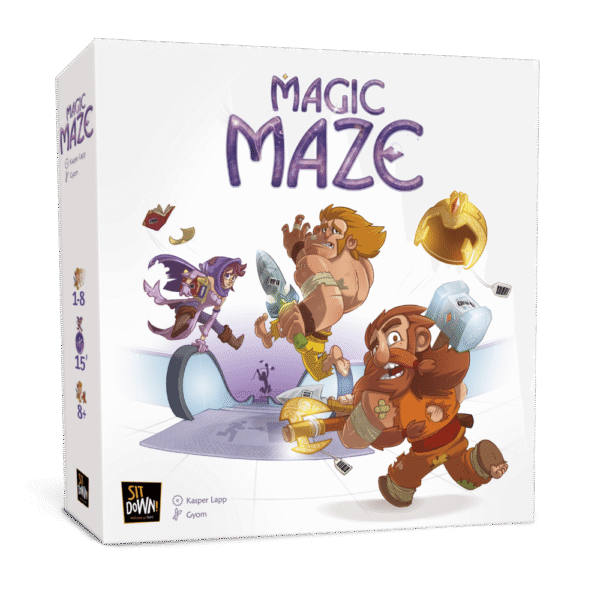
What if your family enjoys working together but still craves the healthy tension and pressure some games bring? You guys need that adrenaline-pumping race to the finish. Magic Maze requires something different: extremely limited verbal communication. Most communication is done through eye contact and the beloved “Do Something!” pawn. (Yes, that’s really the name.) Players are a group of fantasy characters who have lost all their possessions. How can an elf fight without a bow, or a dwarf without his axe?
The solution? Run through the Magical Maze Shopping Mall to gather new tools. Nobody plays one hero alone. Instead, each player can move any character, but only using the specific actions assigned to them, such as moving left or taking an escalator. When someone sees a chance to move the hero to a new spot, jump in and move! Everything plays out simultaneously in real time, with a sand timer counting down.
Magic Maze taps into the puzzle and spatial-reasoning side of learning. Observation is key, along with the ability to think under pressure. It still requires each player to understand what their teammate can do and coordinate silently. If you see something that another player doesn’t and really need to tell them, tap the “Do Something!” pawn on the table to get their attention. Escaping the Magic Maze Shopping Mall requires fast-paced teamwork. The best part? During most of the game, nobody can overstep and tell everyone what to do because that is against the rules!
The original Magic Maze can sometimes be harder to find at major retailers, but used copies are readily available (and who doesn’t like a good bargain?). The game has been such a hit that they’ve also released Magic Maze Tower and Magic Maze Pocket, two newer standalone options that are currently easier to find in the U.S.
Complete the Mission: The Crew
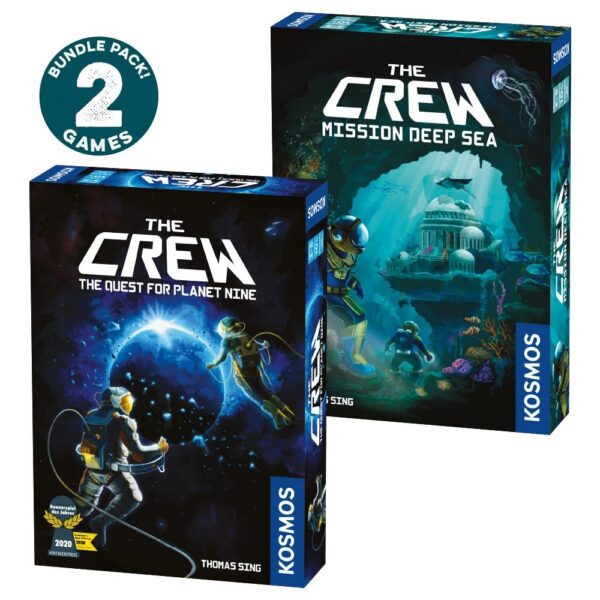
When you’re trying to guarantee a family game night amid everyone’s busy schedules, mission-based games can be a great solution. The Crew is a “trick-taking” game (think Spades, Hearts, or Euchre, where everyone plays a card and one card wins the trick) but with a cooperative campaign twist. Everyone knows the round’s objective, but communication is limited, and players must infer what another player is trying to accomplish as they play cards. Progressive missions feel like a campaign, with easy opportunities to pause, pack up, and return later.
The Crew offers a variety of themes:
- The Crew: The Quest for Planet Nine — Complete 50 different missions across the solar system to find a mysterious new planet.
- The Crew: Mission Deep Sea — Together, search for the lost underwater continent of Mu! This deep-sea adventure requires careful attention, inference, and coordinating which player needs to win each trick.
- The Crew: Journey to the Ends of the Earth — In this newer version of the series, which is still great for new players, everyone races around the world to search for Charlemagne’s secret treasure. Work through 25 stages, and each time you play through the missions, your story might end differently!
- The Crew: Family Adventure — Marooned in Paradise — Easy-to-learn rules make it easier to include younger players while still entertaining the whole family. Help the family escape the desert island through 35 missions and carefully coordinated decisions to get back home.
All versions create great learning opportunities through strategic communication, adaptive strategies, and piecing together missing information. I’ve played all the versions and love Family Adventure for including younger players, and the other three when I want just a little more complexity for my older children.
Remember Together: Wilmot’s Warehouse
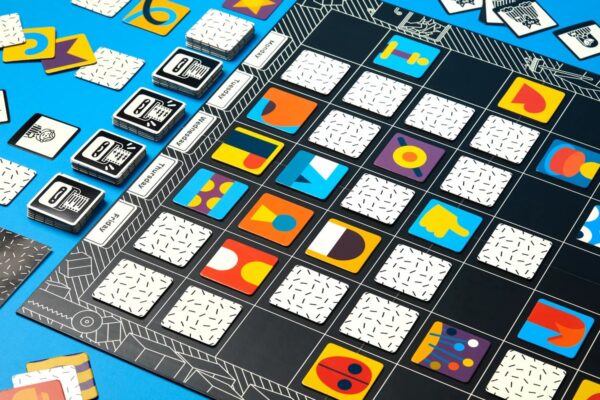
Wilmot’s Warehouse feels a little like discovering a secret menu item. Plenty of people haven’t heard of it, but the moment you find someone who has, they light up and tell you how good it is. It flew under the radar for a while, then suddenly started popping up on game awards lists and getting the kind of attention that makes everyone else ask, “Wait… what is this game?”
After finally playing it myself, I get it.
Wilmot’s Warehouse is a cooperative memory game where players work together to organize hundreds of strange little product tiles into categories that make sense to them. The trick is that those categories don’t have to make sense to anyone else! You might group things by color, shape, theme, or some completely ridiculous story that only your table understands.
At our table, one strange-looking duck tile somehow became the “Monongahela Duck,” who was apparently now a mutinous duck and belonged next to Bigfoot’s foot. Did any of that make logical sense? Absolutely not. Did we remember where those tiles belonged later? You bet we did.
That shared silliness is part of what makes the game work. Players naturally practice memory, categorization, association, storytelling, and communication without it ever feeling like a memory exercise.
And if the words “memory game” immediately make you think, “Absolutely not, my brain does not work like that anymore,” don’t worry! That’s where the cooperative part shines. You’re not expected to remember everything on your own. Maybe someone else remembers the category you forgot, or the ridiculous story you created brings it back. And if nobody remembers? At least you all forgot together!
Cooperative Board Games at a Glance
| Game | Educational Benefits | Best For |
|---|---|---|
| EXIT | Logic, deduction, problem-solving | Puzzle lovers |
| Pandemic | Strategic planning, decision-making, collaboration | Strategic thinkers |
| Magic Maze | Nonverbal communication, spatial reasoning | Families who enjoy fast-paced games |
| The Crew | Deduction, inference, adaptive thinking | Card game enthusiasts |
| Wilmot’s Warehouse | Memory, categorization, storytelling | Creative thinkers |
Captain’s Log: Let Everyone Take the Helm
One thing to remember: cooperative does not always mean collaborative. It can be tempting for one strong player to start directing everyone else’s moves, especially when parents are playing with younger children. Suddenly, one person is playing the game while everyone else is just moving the pieces!
Sometimes the better part of a cooperative game is simply letting everyone contribute in their own way. Kids may spot something you missed, suggest a completely different approach, or make a choice that isn’t the one you would have made. That’s part of the fun. I can’t tell you how many times someone younger at the table has pointed out the completely obvious thing sitting right in front of me while I was busy planning three moves ahead! Just recently, my ASL Lab students repeatedly spotted valuable spaces before I did while I was ready to send our little character somewhere completely useless.
Winning feels a lot better when everyone actually had a hand in getting there.
Losing Together Is Learning, Too!
Cooperative games also change what losing feels like. “We lost” is very different from “You beat me.” Instead of one person carrying the disappointment, everyone can look at what happened together. Did we communicate well? Did we take too many risks? What could we try differently next time?
That creates a natural learning cycle: try, fail, adjust, and try again. Persistence, reflection, and problem-solving happen around the table without a worksheet in sight.
Ready to Roll? Make Teamwork Part of Gameschooling
Cooperative games don’t remove competition; they simply change the opponent. A young child can learn how to work toward a shared goal, an older child can practice evaluating risks, a teenager can learn to communicate with incomplete information, and parents might even practice not telling everyone what to do!
Most importantly, everyone gets to tackle the challenge together.
Does your family have a favorite cooperative game? I invite you to join other parents and me in our Homeschool Connections Community or our Facebook group. Let’s keep the conversation going!