Eight Reasons Music Education Belongs in Every Homeschool
Why Your Child Should Learn an Instrument
I grew up in a musical family. My father was a blues bass player, and my grandfather was a jazz pianist. Some of my earliest memories are of being dragged along to my dad’s gigs with his band or trying to watch TV over the sound of him and his friends practicing in the basement. There were always guitars, microphones, amplifiers, and P.A. systems everywhere. My brother and I adopted music almost by osmosis—my brother had started drumming around age 8 and by adolescence I had started thumping away on my dad’s bass guitar when he wasn’t using it.
My parents encouraged us to dabble in music, and when my dad saw we were showing interest, he bought us both our own instruments. For my 14th birthday, my dad bought me my own Fender P-Bass, and my brother got his own drum set. We started jamming in my basement. My dad, my brother, and I were all in bands; the house was always filled with music of all sorts. It was loud, and occasionally it was messy (you can’t imagine how many cables we had lying around), but it was wholesome, and it was a ton of fun!
Benefits of Music Education
When we homeschool, we may not immediately think of music as one of our child’s core subjects; it can be hard enough to keep up with math and writing! However, I have come to think that music ought to occupy a privileged position in every homeschool curriculum. In olden days, music was an integral part of classical education. It was one of the seven liberal arts because of its mathematical and physical principles. Some have even called music the “soul of the liberal arts.”
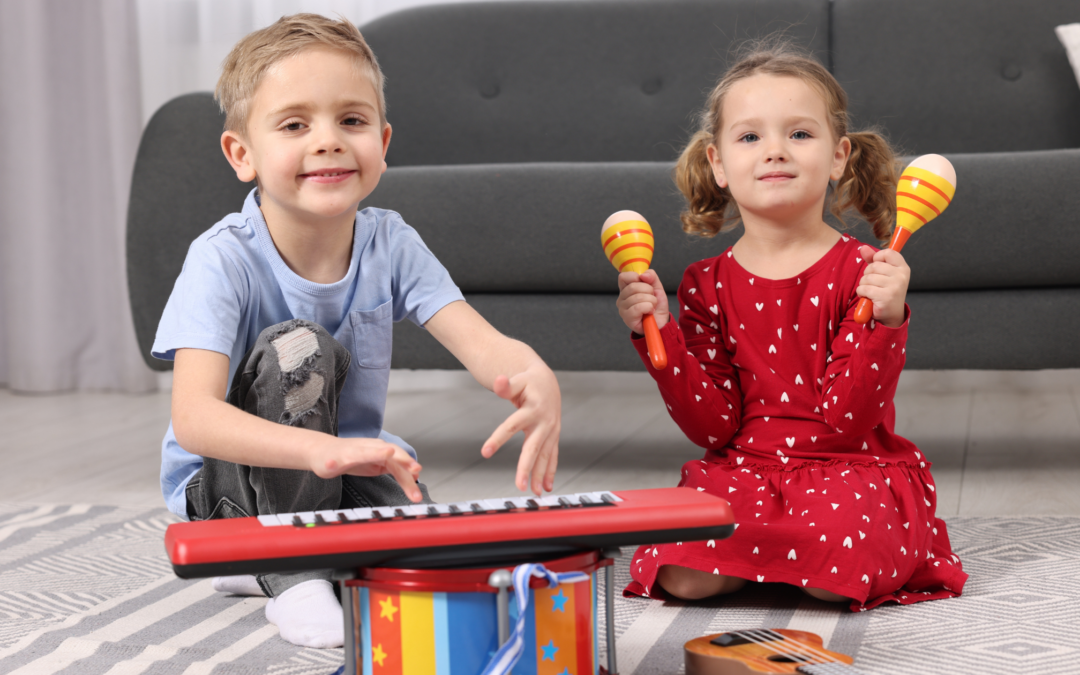
There are many cognitive, behavioral, and social benefits to formal music study as well. Let’s review some of them…
Brain Structure Development
Neuroscientists have observed that learning an instrument before age seven can create long-lasting structural changes in the brain, particularly in areas responsible for motor control and auditory processing.
Enhanced Memory
Both reading sheet music and playing by memory exercise the brain’s information-retention muscles, leading to better overall memory recall that extends to all aspects of life.
Verbal and Mathematical Skills
The rhythmic and tonal structures of music activate neural pathways associated with language development and complex mathematical reasoning. Music is inherently mathematical, and learning to read and play enhances mathematical reasoning.
Building Discipline and Patience
Getting tolerably well on any instrument takes a lot of time and dedication. Learning to master difficult pieces teaches children that continuous effort and patience yield rewarding results.
Emotional Regulation
Playing music is so emotionally soothing! Music provides a safe, non-verbal outlet for children to express feelings, which can significantly help with managing anxiety and stress.
Boosts Self-Esteem
I will never forget what a milestone my first public performance was! Hitting musical milestones—such as mastering a challenging song or performing in front of an audience—builds profound self-confidence.
Fine Motor Skills
Playing requires intense hand-eye coordination and fine motor control, which refines physical dexterity.
Collaboration and Teamwork:
Participating in bands, orchestras, or choir groups teaches children how to listen to others, work as a collective unit, and share in collaborative accomplishments.
Types of Music Education
There are a variety of ways you can introduce your student to music. The most formal way is with structured lessons on a specific instrument taught by an experienced professional who understands both the theoretical and practical aspects of the instrument (e.g., a piano teacher who will teach your child to read musical notation along with the requisite finger practice). This is the most thorough and time-tested way to learn any instrument.
But the great thing about music is it can be learned informally as well. There are a great many fine musicians who have successfully mastered an instrument by ear without a strong theoretical foundation. I had mastered the six-string and bass guitar by age 20 while having minimal knowledge of the modes and scales; I self-trained on piano without ever understanding notation.
There is a lot that can be learned these days from YouTube tutorials, and the benefits of this method are that your child can learn to perform pieces relatively quickly. Of course, the gaps in theoretical knowledge can hurt down the road (after twenty years of winging it on piano, I finally signed up for formal lessons this year to learn music notation), but if you’re looking for something that is quicker and less structured, self-teaching is a fine way to go and has produced many fine musicians.
Let’s not forget that the voice is also an instrument. A choral education in the performing arts checks all the boxes for a robust music education. I spent two years in my high school’s acapella choir and went on to perform vocally in bands and parish choirs on and off throughout my life. The discipline required to read music and sing in a choral setting is a fabulous way to give your child a music education! Remember the dictum of St. Augustine, “He who sings prays twice.”
In Closing
So, as you’re putting together your homeschool curriculum this year, save a little space in there for music education. I am so glad I grew up around music and was able to express myself musically. It is probably the single greatest gift my parents bestowed upon me. With music, you are giving something priceless to your children that can bless them their entire lives through.
What are your thoughts on this topic? I invite you to join other homeschooling parents and me in the Homeschool Connections Community or our Facebook group.