4 Ways to Teach Children the Joy of the Resurrection
Before I was a practicing Catholic, I did not realize the centrality of Easter in the Christian year. Like many secular people, I paid much more attention to Christmas. Easter was kind of an afterthought, a nice spring holiday with some eggs, baskets, and a home-cooked meal.
It was not until I received Confirmation at the Easter Vigil in 2002 that I began to understand how pivotal Easter is for Catholics. The entire liturgical year is structured around it! And why shouldn’t it be? After all, the events of Holy Week and Easter were the culmination of God’s saving plan for mankind. It is right for us to celebrate our salvation so fulsomely!
But how do we truly enter into the celebration of Easter in an impactful way? Fast forward a few years to when I had kids of my own, and I struggled a bit to figure out what the Easter season should look like in a Catholic home. Advent and Lent are easier; they are rich in traditions that give these seasons their distinctly preparatory nature. But what about once Easter has happened? How do we live the joy of Easter during the Easter season?

We spend a lot of homeschooling effort forming our children in Truth. But Easter invites us to go a step further—to form them in joy. Easter isn’t just something that happened. It’s something that changes everything.
Here are a few ways I’ve learned (often imperfectly) to help that joy take root in my home.
1. Make Your Festivity Visible
There are tons of resources available for explaining Easter to children. But children don’t learn joy through explanations. They learn it through experience. Instead of trying to say everything, what if we focused on how I can show more Easter joy through festive actions?
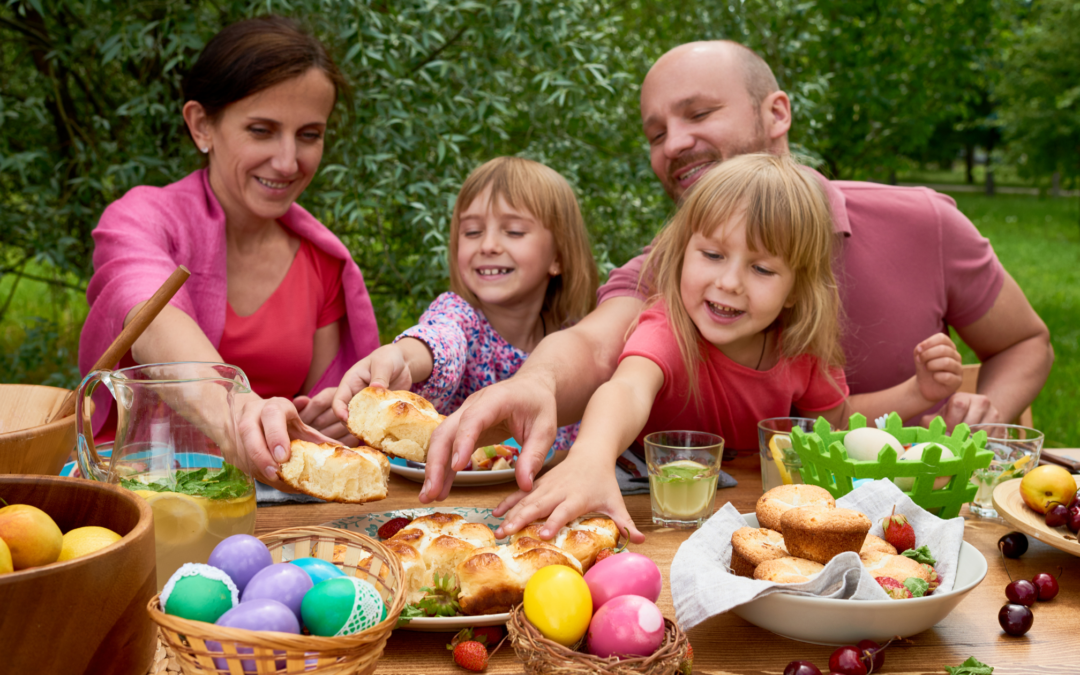
There are lots of little ways we try to express this joy in my household. We linger a little longer at meals. I bring out foods we don’t usually have (with lots of desserts). There are candles on the table. I like to keep some uplifting music on in the background throughout the day during Easter week. Usually, I get some Easter lilies and set them up at home.
One year, almost without thinking, I left up some of our more somber Lenten visuals well into Easter week. I have a prayer table with a cloth I switch out according to the colors of the liturgical year, and I lazily had the purple up well into Easter week. The house didn’t feel as festive, and that impacted everyone. Now I make sure we make a visible change to correspond to the spiritual transformation Easter represents.
None of this is elaborate, but it is intentional. This sort of thing helps Easter to seem more like a season, something that is not only understood but felt and experienced.
2. Linger on the Resurrection
When doing religious education, instead of treating the Resurrection as a single story we “cover,” I’ve learned to stretch it out.
We read one Gospel account at a time, sometimes over several days. And instead of rushing to explain, I’ve started asking simpler questions to help draw my kids’ minds into the narrative. Simple questions like “What do you think she felt when she realized it was Jesus?” and “Would you have recognized Him?” can lead to interesting and impactful conversations.
The answers aren’t always profound. Sometimes they’re funny. Sometimes they wander. But the point is to help your children step into the story rather than stand outside it. It’s really just the classic method of Scriptural meditation proposed by St. Ignatius Loyola, where we imagine ourselves in the Gospel scenes as a way of connecting with the narrative.
3. Deliberately Cultivate a Joyful Attitude
Many of us think of joy as something that just kinda happens; as something you either have or you don’t. Over time, however, I have come to see joy as something we choose, and even practice—especially in the Easter season.
Life is always going to have small frustrations, of course. Someone complains about a chore. Someone else argues with a sibling. Things break. Bills are due. Those things don’t disappear after Easter Sunday.
But now I find myself gently tying those moments back to something bigger. Because of what Christ has done, I don’t have to let these little disappointments define my attitude. I can choose joy. I can choose joy boldly, even recklessly, in the face of life’s challenges.
This isn’t about forcing an artificial happiness; it’s about slowly forming a habit of hope that gives birth to a sincere disposition of joy and gratitude, regardless of what life gives us. Modeling this joy makes a huge difference in your household. It not only makes you pleasant to be around, but more importantly, it teaches your children how to handle the crosses of life with grace.
4. Don’t End Easter Too Soon
This has probably been one of the biggest shifts in our home. We Catholics often complain that the secular world does not treat Christmas like a season—for the world, Christmas is celebrated as a single day, and then back to the workaday world.
We Catholics can do the same for Easter. For a long time, Easter felt like a beautiful day, and then it was over. But the Church doesn’t treat Easter that way. Easter is a season—a long one! At 50 days, the Easter season is longer than Advent or Lent. Given that, shouldn’t we take deliberate effort to keep the season alive?
It doesn’t have to be anything dramatic. It’s basically just ensuring consistency in the things mentioned above throughout the entirety of Eastertide. Sometimes it’s just a reminder, “We’re still in Easter.” The point is to remind our kids that Easter isn’t a peak that fades. It’s something that continues on until Pentecost.
Christ is Risen Indeed!
If there’s one thing I’ve had to relearn over the years, it’s this: Easter is too important to be treated as a single day. We can clearly explain the facts of the Resurrection. We can make sure our children know the apologetics. But if our homes don’t reflect it—if nothing really changes in how we live, celebrate, or carry ourselves—then something essential is missing.
The Church gives us 50 days for a reason. We are meant to sit in the joy of the Resurrection, giving it time to work its way into our ordinary lives. Because if Christ is truly risen indeed, then that ought to make a real and substantial difference in our daily lives.
What are your thoughts on this topic? I invite you to join other homeschooling parents and me in the Homeschool Connections Community or our Facebook group.