Homeschooling: Light in the New Dark Ages
In the humdrum of our daily grind, it is easy to lose sight of the forest for the trees. Your Catholic homeschool is more than a beautiful, chaotic mess of books and laundry. As a Catholic homeschooler, you are actually part of one of the great movements of human history!
Homeschools as the “Monasteries” of Modern Life
Many years ago, I remember Father Joseph Fessio, the founder of Ignatius Press, likening the Catholic homeschooling movement to the monasteries of medieval Europe. This is an incredibly apt comparison! The so-called Dark Ages that followed the collapse of the Roman Empire were quite similar to our own age in many respects. The Roman Empire was invaded from without and corrupted from within. From the outside, the barbarians destroyed much of the civilization Rome had built. From within, the Arian heresy, which denied the Divinity of Jesus, had damaged the Church beginning in the fourth century.
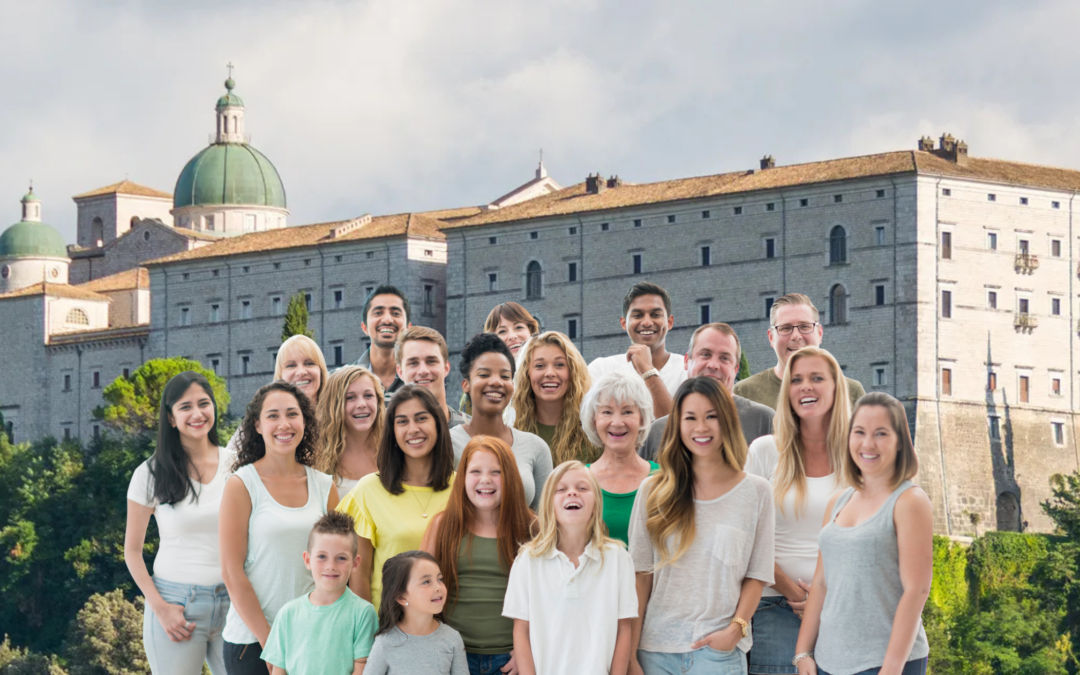
Fortunately, that was not the end of the story. In the first half of the sixth century, God raised up St. Benedict, who established the first Benedictine monastery at Monte Cassino, followed by many more monasteries. Guided in their development by Benedict’s Rule, the Benedictine monastic system quickly spread throughout Europe, both restoring and evangelizing the culture, enlivening it with a Catholic ethos.

Medieval European civilization was permeated by monasticism. It is estimated that at the height of the Middle Ages, there were somewhere around 37,000 monasteries in Europe. By the 13th century, Europe had about 70 million people, approximately one-fifth the current population of the United States. If the United States had the same proportionate number of monasteries, we would have 185,000 monasteries in this country. To put that in perspective, that would be close to 1000 monasteries in every American diocese.
We certainly do not have anything close to that number of monasteries in our country today. Still, we do have something equivalent in the homeschooling families who are preserving our Catholic faith and culture. Homeschooling is rapidly becoming as prevalent today as monasteries were in medieval Europe. Current studies estimate that as many as 10% of all children today are homeschooled. What if instead of 1000 monasteries, we had 1000 Catholic homeschooling families in each American diocese? Surely this would cause a cultural revolution in this country!
Homeschools: Lights in the Darkness
Monasteries grew throughout Europe as people were attracted to what the monks offered. Those who saw how the monks lived wanted to live that way themselves. Those who saw the faith and joy of the monks, wanted that faith and joy themselves—not to mention the practical benefits the monks brought to their communities through their hard work, commitment to education, and technical innovation.
We see an analogous trend in our own day. Today, more and more people see Catholic homeschooling families and realize that they want what those families have. They want that type of committed family and home life. They want that type of active faith. They want to know where to go and what to do with their lives. They want the benefits that Catholic homeschooling so clearly confers on children, families, and communities.
What they see are Catholic homeschooling families regularly receiving the sacraments of the Holy Eucharist and Penance, saying the daily Rosary, and revolving their family life around the feasts of the liturgical year. They see Catholic homeschooling families active in Pro-Life activities and volunteering at their parishes. Catholic homeschooling is not superficial to the life of these families, nor to the life of the Church, nor, I dare say, to the life of our nation. It is central! Catholic home schooling is a principal cause of hope for overcoming the secular values of our society. Catholic home schooling is an essential key to authentic Catholic renewal, a light in the darkness of our increasingly hostile culture.
The connection between homeschooling families and monasteries is compelling. It is up to us to preserve the faith as surely as it was the monks’ duty to restore Europe’s culture after the fall of Rome. What the Church needs are saints and scholars willing to completely reject the world’s current system to pursue the faith with singular purpose and devotion. This is what made the “Dark Ages” one of the brightest times in Church history. The Second Vatican Council’s document Lumen Gentium called the family a “domestic church” (LG 11). If the family is the domestic church, perhaps we should think of our homeschools as the domestic monastery!
Conclusion
In a world that often feels chaotic and disoriented, your homeschool stands as a small but radiant stronghold of faith, culture, and renewal. By living your vocation with intention and love, you participate in the same quiet revolution that once transformed a collapsing civilization. Take heart, your daily faithfulness is forming saints, shaping the future, and adding one more bright light to a world in need of hope.
What are your thoughts on this topic? Join other homeschooling parents and me in the Homeschool Connections Facebook Group or in the HSC Community to continue the conversation.