Homeschooling American Literature: Bringing History to Life Through Great Books
Interview with Marlana Weber on Early American Literature
I’ve been at Homeschool Connections a long time—sixteen years this fall! I’ve been privileged to work with many fine people over those years, both instructors and admin staff. One of my HSC peers I have collaborated with closely over the years is Marlana Weber. Marlana was my course monitor for several years before she moved up into teaching. Now she is an instructor for HSC’s American Sign Language courses for 3rd to 12th grade, as well as a new series of courses on Early American literature.
Today I will be talking with Marlana about these literature courses, which all HSC parents should definitely check out, especially if you’re interested in unit studies that can tie literature and history together. (Currently available in recording through Unlimited Access.)

Before we talk about the course, please tell us a bit about yourself and your background in literature.
I’ve worked with Homeschool Connections for nearly five years, and this is my third year teaching for them. Before HSC, I have worked in education in some capacity since 2006, ranging from paraeducator to substitute teacher, homeschool teacher, and classroom teacher. I earned my Bachelor of Arts in English from National University, where I received an outstanding education in literature and English. I’m still a proud “Navigator.” I am currently a graduate student at St. Vincent College, pursuing a Master’s in Education in Curriculum & Instruction and a Reading Specialist Certificate.
Since I was a young child, I have always loved reading and writing. That passion stayed with me as I grew older and inspired me to pursue my undergraduate degree in English. My degree was heavily emphasized in literature, so I read a wide variety of genres throughout my college courses.
I’m incredibly grateful for the way my program was structured and the professors I had. It gave me a diverse background in literature, from ancient texts like Gilgamesh to classic works of Shakespeare, and all the way to modern and world literature. As much as I enjoy delving deeper into literary works, I love sharing that passion with students and making reading a fun, exciting experience that connects them to their own world.
Tell us a bit about Early American Literature. How is the class set up, and what inspired you to put this course together?
I like to think of the inspiration for Early American Literature as a classic, “Ah ha!” moment. I was monitoring your American history course when you brought up The Great Gatsby. We both started telling the students how great the book is and encouraged them to read it. I remember later that month, we were chatting and thought, “Wouldn’t it be great to have a literature course that coincides with your history course?”
Instead of merely encouraging students to read a book, the idea was born to teach a course that parallels your history course, so students could go beyond just the historical facts and really get into the time period through both literature and history. Not only do they hear the lecture “This happened during these dates,” but they also get the real, immersive, inside perspective from writers from that time.
Haha, I love that the idea started in my course! And I think we should mention, this course was specifically designed to align with my American history courses, Early American History 1492-1763, and Revolution, Republic, and Union 1763-1865. So students who take your literature course and my history courses will find parallels?
Oh yes. The course was designed specifically to align with your American history courses. Students taking your history and my literature course will find that the texts and our discussions constantly refer back to, reinforce, and illuminate concepts from your Early American history. They were meant to pair up and would make a great unit study.
What are some samples of texts students will be working with in your course?
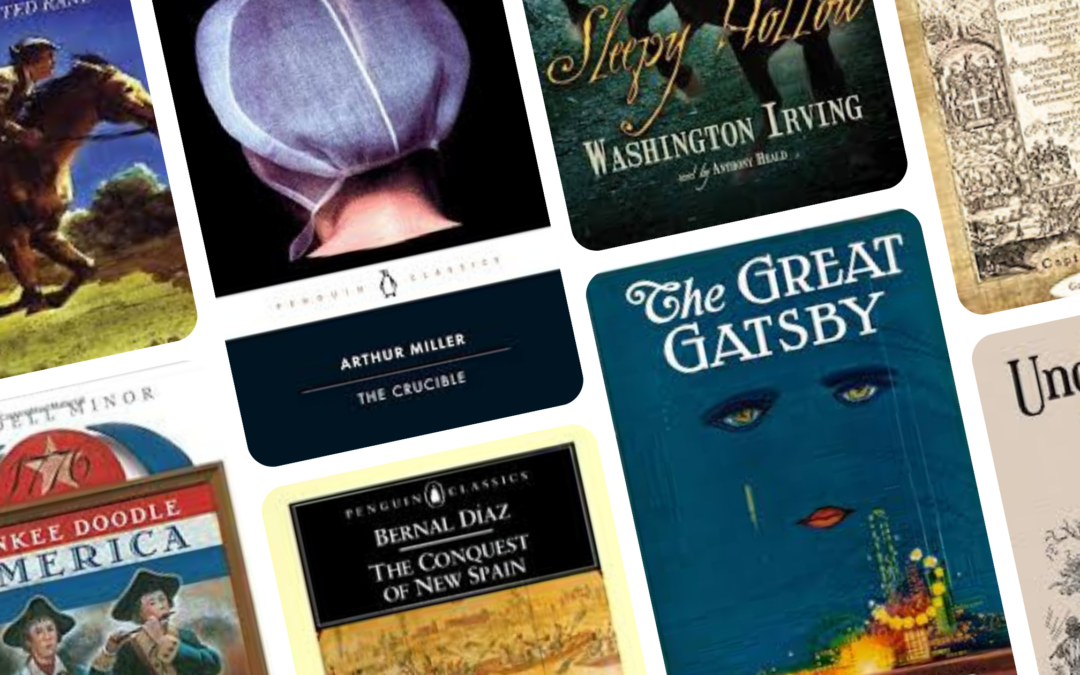
I love giving them a variety of texts to read each week. They’ve read some Native American stories, segments from The Conquest of New Spain by Conquistador Bernal Diaz Del Castillo, The General History of Virginia by John Smith, poetry by Anne Bradstreet and Edward Taylor, and much more. Coming up, they’re going to read the play The Crucible by Arthur Miller, read about the first Catholic martyrs, and even break down the literary side and origins of our classic American song, “Yankee Doodle.” Of course, that’s just a small portion of what they have read or will read the first semester!
I love that you are working in some primary sources alongside more traditional “literary” texts! This is great because I have heard people argue that literature from this period is inaccessible to modern teens. What do you say to that?
I love proving them wrong!
By breaking down the sometimes lofty text or introducing portions of it, rather than an entire book at once, they find it more manageable to read. I work on breaking down sections and, most importantly, on constantly keeping students engaged through questions so they can relate it to their own lives. One of the most rewarding moments in teaching literature, especially in early American literature, is when I see students relate to the author and the text.
Instead of just giving them a lecture on the author’s background and the literary devices in the work, I continually ask them questions so they can find a way to connect with the reading. I give them the others as well, but I’m so proud when we finish a class, and I know they’ve found a new appreciation for what they read.
How big is the workload for the course in terms of weekly reading?
The reading is not much more than a couple of hours per week, and I give them a variety in the workload. While some weeks they might have a heavier load of 20 pages, other weeks I’ll lighten it up or just give them some poetry to read and think about for the week. My goal is to help them enjoy literature, not groan or run away in fear! For avid readers, I try to show them where they can continue reading. And for those who like lighter loads, I want to assure they aren’t overwhelmed. I think it’s essential for every reader, at every level, to feel they can partake and contribute to the class.
There are lots of great names in literature during this period. Who is one who stands out to you? Favorite author or work, and why?
One of my favorite works that they read segments of this semester is by the conquistador Bernal Diaz del Castillo. His memoir is unique among those of that period because he writes in the first person, which was uncommon at the time. The narrative brings Hernán Cortés’s expeditions to life. I really love reading The Crucible with them because Arthur Miller takes us on a fascinating journey into the past and offers a lot of insight into community interactions.
Any further literature classes on the horizon? Where should students look after completing Early American?
During the second semester, we’ll continue the second party of Early American Literature, reading up to the Civil War (and some of my favorite authors!). I plan to continue American Literature in future school years, covering the Civil War to modern times, and to provide European and World literature later on, as well as some light book clubs along the way
Continuing the Conversation
If you’d like to continue this conversation, you can join Phillip, Marlana, and other homeschooling parents in the Homeschool Connections Facebook Group or in the HSC Community.
You can also find Marlane here: