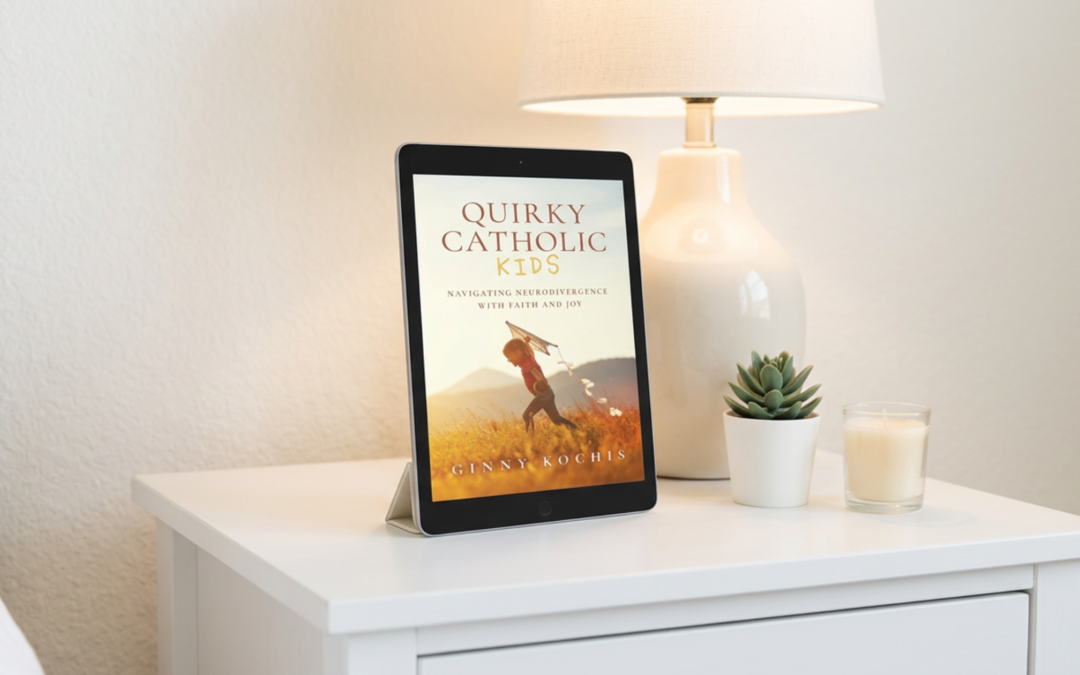
Book Review: Quirky Catholic Kids
Redefining Quirky
How many times have you started your homeschooling day with the best of intentions? You saw this great activity on Instagram and followed up with a step-by-step guide on Pinterest for making a glorious stained-glass art project that looks just like the Basilica Sagrada Familia! You have all the tools ready to go, and it’s going to be a beautiful, picture-worthy project to share with all your friends (especially the public school ones, because, you know, we homeschool and have to prove how much better it is!).
Instead, you hear a cacophony of complaints: it looks too hard, it’s boring, he stole my color, the paper is too thin, it’s breaking apart, I don’t like it sticking to my hands, the glue feels weird—oh, hey, the glue feels much better smeared all over the kitchen table—he said mine looks ugly, why can’t I just watch a video? The youngest starts crying, the oldest keeps saying they’ll be there in five minutes, the dog starts barking at the FedEx driver, and by the end, it’s like someone took a down pillow of colored tissue paper and threw it all over the room. Inevitably, some child is crying for God-knows-what reason.
So much for the Facebook photo of the “oh so easy” stained glass project. It is pure chaos, and you’re on the brink of a meltdown yourself because everyone else can do this, so why can’t I? Why can’t my kids just be NORMAL?*

*These situations may or may not have been pulled in varying degrees from the Weber Household… Okay, they were.
If this sounds all too familiar, Quirky Catholic Kids by Ginny Kochis needs to be in your hands. As Ginny explains so beautifully, we know God didn’t make our children a mistake, but He MUST have made a mistake in putting us as their parents, right? He certainly did not! She beautifully navigates the realities of parenting and educating in a neurodivergent household, offering real, practical, and deeply understanding advice for raising unconventional children.
Discipline v Support
Let’s address the elephant in the room: society’s attitude that “misbehavior connotes a need for discipline.”
I’m sure we’ve all had someone turn to us at the grocery store mid-meltdown, or during church when we’re wrangling a noisy kid—and we all have an Aunt Susie who loves to remind us, “Back in MY DAY…” However, Ginny reminds us that this is not always the case for neurodivergent, or “quirky,” children. Do we completely throw discipline out the window? Of course not. But as their parents, we know instinctively when a situation requires discipline versus support. The outside world does not know your children as you do. Ginny fills Chapter 3 with fantastic advice on how to distinguish between a tantrum and a meltdown, and between discipline and support.
Practical Tools for the Homeschool Room
Part Two of Quirky Catholic Kids is an absolute goldmine of practical advice, humor, and effective strategies. Sometimes we just need a reminder that people develop on different timelines, and neurodivergent kids, in particular, are masters of asynchronous development.
When it comes to actual instruction, Ginny reminds us that hyperfixation isn’t always a bad thing. (She gives a great shout-out to Marie Curie and DNA scientists to prove that hyperfocus often leads to groundbreaking discoveries!) But as a teacher, I know how difficult it can be to redirect a child who is hyper-fixating on dinosaurs when they really just need to finish their multiplication facts. This is the section of the book where you will want your highlighter. Ginny breaks down highly effective, actionable steps—like the “chunking” method and specific transition strategies.
But my absolute favorite section of advice? Chapter 11 on Executive Function. Ginny explains the neurological struggles behind executive functioning and offers a plethora of ways to strengthen that “mental muscle.” And my favorite tool she suggests for building it? BOARD GAMES, of course! (You know I loved seeing that!) Even if you aren’t a massive tabletop gamer like me, her practical tips in this chapter alone are worth the price of the book.
Faith in Practice
I think every parent reading this, with a neurodivergent child or not, has had mortifying moments during Mass while trying to figure out the balance of “kids being kids” versus when to intervene without causing a disruption. Tack on a neurodivergent brain, and you can have some moments that make you want to crawl into the crypts under the Vatican to hide. Yet, sometimes we see and hear the most beautiful expressions of our faith through a neurodivergent brain. That beautiful mind, however, doesn’t inherently come with a manual on how to balance the struggles in the pew. Quirky Catholic Kids offers multiple examples and chapters reminding you to have patience and grace with yourself and your children, along with highly practical tips on handling Mass and the Sacraments with those “quirky” minds.
What truly sets this book apart from a secular psychology manual is the spiritual companioning. In Part Two, each chapter is followed by a story tied to a neurodivergent saint. Yes, even some of our greatest saints were likely neurodivergent! Seeing St. Joseph of Cupertino paired with executive functioning, or Servant of God Léonie Martin paired with emotional regulation, is incredibly validating. Ginny does a remarkable job sharing these inspiring stories, and she even includes a massive appendix listing 100 patron saints and intercessors categorized by specific interests and needs.
Final Verdict and the “Aha!” Moment
With all these tools—saints, strategies, and psychological insights—you might think the greatest gift this book gave me was my own peace of mind. But the most powerful moment actually came when it was time to put Chapter 10 into action and talk to my own son, Christopher, who was diagnosed with ADHD and Level 1 Autism last summer. I still had not talked to him about it.
Chapter 10, “When to Talk to the Kids,” was one of the most important and inspiring sections for me. Ginny explains the profound benefits of sharing a diagnosis and offers concrete advice on how to do it. As a parent, getting a diagnosis for your child is scary. Your mind is already racing with the next plan—or battling denial, as Ginny and I both experienced. But trying to figure out how to tell your kids about it without making them feel broken is absolutely terrifying.
This chapter made my brain spin like a hamster on a wheel, but in the best way possible! By the time I finished it, a massive weight had lifted off my shoulders. It made the prospect of talking to Christopher feel much less frightening and, most importantly, completely necessary.
I picked up Quirky Catholic Kids hoping it would give me, as a mother, some peace of mind and sanity. But its ultimate gift was giving my son the grace to finally understand himself.
Ready to grab your own copy? You can find it HERE. (Disclosure: I received a free copy of this book from Sophia Institute Press in exchange for an honest review, but all opinions and experiences shared here are my family’s own!) If you’d like to go deeper into this topic, I invite you to join me in the Homeschool Connections Facebook Parent Group.
EDITOR’S NOTE: Ginny has been a guest on the Homeschool Connections Podcast many times HERE. We invite you to check out her episodes, which are packed full of great advice and heartfelt experiences.