Roll Call: Spotlight on Diced Veggies
 Finding a gorgeous board game that sneaks in brilliant educational value in your homeschool day or family game night is a win. Finding one that allows you to play with a cardboard cleaver and think veggies are fun, with a helping of mathematics? That’s an absolute masterpiece. *Chefs Kiss*
Practicing math skills can sometimes feel like making homemade caramel. For some kids, it’s a smooth, easy process with the sweet reward of accomplishment. For others, it’s like a delicate, high-stress recipe where you’re constantly keeping track of the candy thermometer, making sure the balance stays perfectly in the zone: not too hot, where frustration hits, and everyone melts down. And not so cold that you lack any progress. It can certainly be a battle to keep everything just right.
When the math lesson starts to burn, board games are the ultimate palate cleanser. By swapping a stressful workbook for a mathematical dice game, you instantly lower the anxiety in the room. It creates a balanced environment that challenges advanced learners while supporting those who struggle.

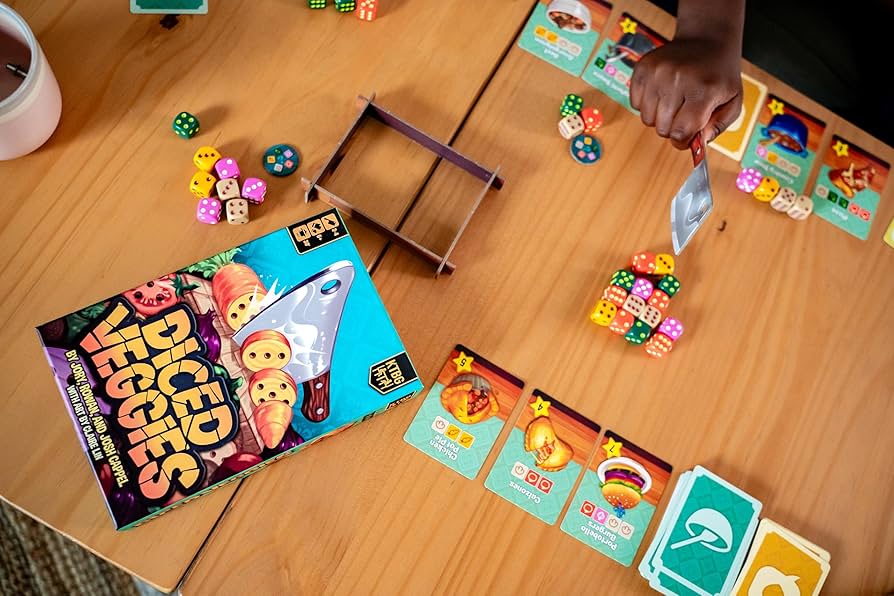
Diced Veggies by Kids Table Board Gaming (KTBG) is the perfect example of this. It is a robust math engine completely disguised as a culinary adventure. Let’s take a look at the savory success of bringing this game to your table…
Mission Briefing: The Essentials
• Genre: Dice Rolling, Set Collecting, Hand Management
• Player Count: 1-4 players
• Recommended Age: 6+
• Play Time: 30 minutes
• Theme Versatility: Includes a Solo Variant and “Youngest of Players” Variant
• The Concept: Players step into the kitchen as talented chefs trying to score the most points. Using a cardboard cleaver, you slice “ingredient dice” away from a central block, collect them for your recipe cards, and combine them with clever Hype cards for massive bonuses before the game ends.
The Learning Cargo: Mathematical Ingredients
Diced Veggies is like a grocery cart full of the best ingredients to practice and strengthen those math skills without boring students with strong math fluency, and providing a stress-free environment for those needing to work on it.
Computational Fluency & Mental Math
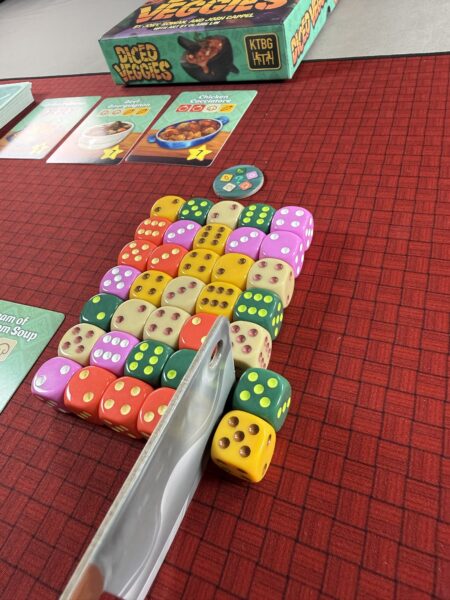
- The Golden Rule: At the core of the game, any cut you make from the block must equal a combined total of 10 or lower.
- Flexible Addition: This creates a fantastic engine for flexible mental addition, forcing players to rapidly scan the board and calculate the best possible legal combination on the fly.
Number Composition
- Visualization: The grid layout provides a tactile way for younger students to physically see and practice number bonds.
- Target Numbers: Kids learn that a “10” isn’t just a 10—it can be composed of a 6 and a 4, a 5 and a 5, or even a 5, 3, and 2.
Multi-Criteria Problem Solving
- Strategic Logic: Math demands strategic thinking, and this game forces players to balance multiple criteria simultaneously to succeed.
- The Balancing Act: A player might desperately need a green pepper and a red tomato, but they have to figure out how to slice them in those specific colors without the numbers exceeding the strict limit of 10.
Advanced Strategic Planning
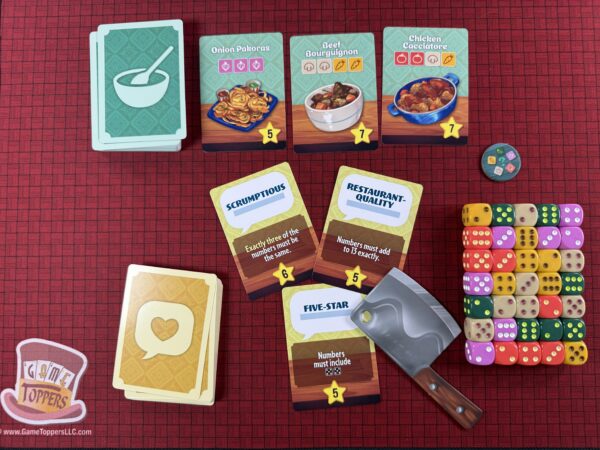
- Exact Calculations: For older players, the Hype cards significantly elevate the math by requiring exact combinations. (Such as managing a hand to add up to exactly 19 or matching three of the same number.)
- Resource Management: Using a Chef Token to mathematically alter a die’s value adds a brilliant layer of resource management and forward-thinking.
Navigating the Game: Customizing the Learning Voyage
For Your Junior Navigators
- Simplify the Menu: Take out the Hype Cards and Chef Tokens! It requires much less reading and allows them to focus on matching, planning, and simple addition up to 10.
- Bite-Sized Portions: Reduce the number of recipe cards to trigger the endgame.
- Adjust the Recipe: Try eliminating down to only three dice (no matter the total). Or make your own target number they need to work on.
- Sous Chef: Bring in an older sibling to support the younger one. They can be in charge of Hype Cards or finding the best matches while the Young Navigator focuses on addition.
For Your Senior Explorers (Teens and Up)
- The “Exact Change” Challenge: Instead of allowing cuts that equal 10 or lower, challenge older students to make cuts that equal exactly 10. This completely removes the “easy way out” of just slicing a 2 and a 3, forcing them to hunt for complex number bonds.
- The “Iron Chef” Timer: Introduce a 30-second sand timer for their turn. This shifts the focus from casual addition to rapid-fire computational fluency and processing speed under pressure.
- The Double Hype: Allow them to play two Hype cards on a single recipe if they can manage to meet both mathematical criteria simultaneously. It requires intense, multi-step resource management to pull off!
Beyond Academics: Why Your Family Will Love It
Diced Veggies is a masterclass in approachable game design. However, its value extends far beyond the math practice. It introduces fantastic life skills in a completely organic way:
- Real-World Resource Management: Throughout the game, players are constantly evaluating what they have versus what they need. It’s the exact same logic we use in meal planning: you have to carefully plan out how much chicken you need to buy for dinner. You don’t want to overspend at the grocery store. But you also ensure you don’t buy too little and leave everyone hungry. It teaches kids to optimize what is in front of them!
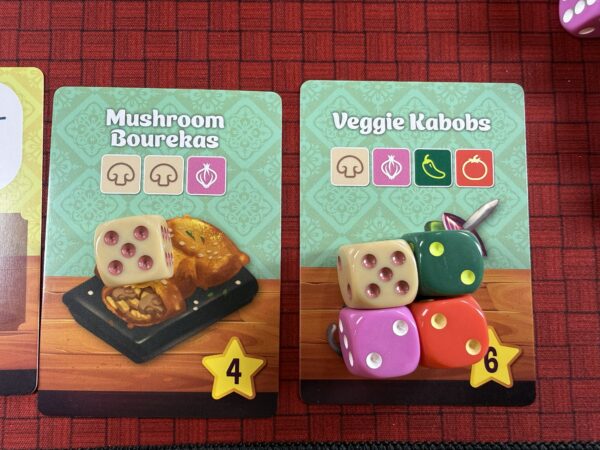
- From the Cardboard to the Kitchen: The recipes featured in the game are real, culturally diverse dishes. A fantastic way to extend the fun of game night is to let your kids pick their favorite winning recipe card from the game, like Stuffed Peppers, and then head to the real kitchen to cook it for dinner together.
- The Tactile Cleaver: Don’t underestimate the power of the cleaver! For students who struggle to sit still or stay focused during traditional board games, the physical action of lining up the cleaver and sliding the dice away from the block provides an incredible sensory anchor that keeps them engaged even when it isn’t their turn.
- Too Many Cooks in the Kitchen? (Independent Play): Sometimes the full game night crew isn’t available. Or you simply need a quiet, independent activity during the homeschool day. The included solo rules allow a single chef to step into the kitchen, practice those exact same mathematical skills, and challenge their own high score. It builds immense confidence and self-directed problem-solving without needing a parent to manage the table.
Ready to Roll? Your Next Steps
Diced Veggies showcases how quickly and easily it is to shift from a stressful math lesson to a joyful family experience. It proves that building computational fluency doesn’t have to require a textbook—it just requires a cardboard cleaver and a little imagination! Go ahead and give this game a try; I guarantee you’ll be amazed at how much math practice is served up in every single slice.
You can find Diced Veggies from Kids Table Board Gaming (KTBG) at Barnes & Noble or directly from KTBG’s website.
Since Diced Veggies is all about becoming the master chef and gathering the perfect ingredients, what is your family’s absolute favorite go-to dinner recipe? Share your culinary masterpieces (or your funniest kitchen disasters!) in the Homeschool Connections Community or our Facebook group.