My Man Godfrey: A Glimpse into a Vanished Society
Homeschooling With Classic Films: What My Man Godfrey Teaches About History
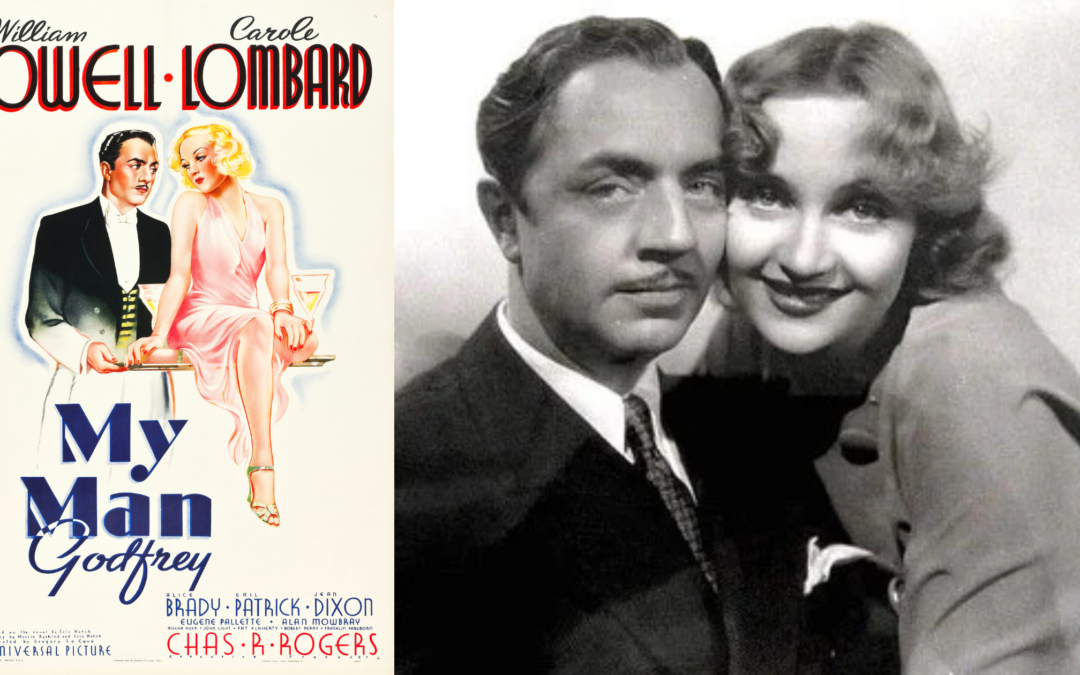
My latest entry in my series on homeschooling through black-and-white film is a real oldie: the 1936 film My Man Godfrey, starring William Powell and Carole Lombard. It tells the story of a young woman’s romantic infatuation with her family’s butler. Along the way, it offers modern viewers a fascinating glimpse into the pre-World-War-II culture of domestic help, an institution long vanished from American life. But before we talk about the film, we need to talk about its genre. Because it, too, is something of a relic.
Screwball Comedy as a Lost Genre
My Man Godfrey is part of the screwball comedy genre, which was very popular during the Great Depression. Screwball comedies were romantic satires of traditional love stories. Usually, it featured a battle of the sexes, with a dominant female character trying to overcome an aloof male’s resistance through an increasingly farcical series of events. What makes a screwball comedy unique is its emphasis on comedy. Contemporary romantic comedies tend to emphasize the romance with hints of comedy. Conversely, screwball comedies emphasize the farce with hints of romance. That is to say, they are comedies first and romances second.

Screwball comedies often contained undertones of class critique and optimistic escapism. They did this partly to give audiences a light-hearted alternative to the dark realities of the Great Depression and the Second World War. Screwball comedies also helped filmmakers evade Hollywood censors. The Hays Code strictly regulated film content. Therefore, directors used farce to explore risqué themes without violating the rules. My Man Godfrey, for example, explores the taboo of romantic boundaries between employers and their hired domestics, packaged as a comedy about the zany antics of a nouveau riche family during the Depression.
Godfrey’s Dilemma and the Forgotten Man
Until World War II, the live-in domestic service industry was still a major sector of the United States economy. Thousands of upper-class American households retained the services of maids and butlers who lived in the home full-time. Many houses even had built-in servants’ quarters, including secondary kitchens, staircases, and storage areas, allowing “the help” to go about their work largely unseen by the family.
In My Man Godfrey, Godfrey is a down-and-out drifter living in a dump by the East River in New York with others who have been displaced by the Great Depression. He is discovered by Irene Bullock, a wealthy socialite who is trying to win a bet with her sister to produce a “forgotten man” as part of a scavenger hunt. Godfrey is at first offended by the idea of being used as a human trophy based on his status to satisfy the silly game of a spoiled rich girl. However, his curiosity gets the better of him, and he goes along with her.
Irene takes a liking to Godfrey and hires him as her family’s new butler, cleaning him up and bringing him into the home. However, Godfrey soon realizes that the Bullocks are no ordinary family. The Bullock children are spoiled rotten, lack any sense of propriety, and continuously violate Godfrey’s personal space. Mrs. Bullock is a silly, frivolous woman with no sense of her obligations to the family. The children recklessly burn through the wealth of their father, Alexander Bullock, a successful investor.
Crossed Boundaries and Romantic Farce
Godfrey begins the film as the “forgotten man” on the outskirts of society. Yet he quickly becomes the most normal and commonsense character in a household of outlandish socialites who are totally divorced from reality. It is not unlike the dynamic in the British comedy series Jeeves and Wooster, where the butler Jeeves is the most level-headed character.
Irene quickly becomes romantically enamored with the mysterious Godfrey and pursues him relentlessly, blowing away professional boundaries and using every trick she knows—fair or foul—to win his affection. Godfrey, meanwhile, has to walk a fine line with Irene to keep his job and avoid returning to the dump. In the process, we learn the interesting backstory behind Godfrey’s misfortune and how he wound up in a dump to begin with.
The Domestic Industry and “The Help”
The dominant theme in the film is spoofing the social mores surrounding the relationship between a family and their hired help. Boundaries are a consistently recurring theme. Godfrey has the ability to help his employee, Mr. Bullock, out of an investment quandary, but not without crossing professional boundaries. Irene Bullock consistently violates Godfrey’s personal space, intruding in his bedroom, demanding his affection, and even kissing him while he is trying to do his job. The Bullock family’s eccentricities continually make Godfrey walk on eggshells around them. Sometimes they humiliate him without even realizing it. One example is when Mrs. Bullock nosily demands that Godfrey share deeply personal details about his past with her lunch guests while he is simply trying to serve champagne.
This is no doubt the theme the movie was trying to explore, and it does it quite well. But as I was watching these absurd scenarios play out, I thought to myself how far removed we are today from such problems. As I have often said, like any film, old movies were made to tell a story, but they often tell a story they did not intend. Old cinema becomes “historical” simply by reflecting the technologies and attitudes of its time. It also preserves patterns of life that have long since vanished. In a sense, these films become the visual equivalent of primary source texts.
Old Films as Historical Documents
They have a value beyond what they intend to say, a value derived merely from their age and their creation from minds long gone.
This is what I noticed when watching My Man Godfrey. Almost nobody alive in 2026 has immediate experience with the social dynamics around live-in hired help. We understand the setup of the “wacky family and clever butler” in the abstract. However, it does not resonate as it did with audiences in 1936, who laughed because they were personally familiar with real-life butlers. In that sense, films about domestic help, such as My Man Godfrey, give us a window into a vanished way of life.
Based on the comedic play on boundaries the movie explores, we can see how Americans a generation ago were still hanging on to a system of institutionalized domestic help that was rapidly disintegrating as rigid caste barriers broke down in the mid-20th century. My Man Godfrey explores this gray zone, where live-in domestic servants are still a thing, but social mores were rapidly shifting. When Mrs. Bullock is told that her daughter is in love with the butler, she flippantly says, “So what? Girls these days run off with their chauffeurs all the time.”
Historical Easter Eggs and Cultural Clues
To the historically astute viewer, there are lots of historical easter eggs in this movie, too. At one point, Mr. Bullock complains of his 60% income tax rate, which is quickly reducing him to penury. To the modern viewer who thinks a top rate of 37% is excessive, Bullock’s gripe serves as an introduction to the astronomically high income tax rates of the New Deal era.
When a hobo asks for five bucks, Mrs. Bullock says, “What are bucks?” In 1936, the slang term for dollars had not yet percolated into the upper crust, and the character’s ignorance of blue-collar vernacular is meant to highlight her social aloofness. There are also some interesting social observations that even I was surprised by.
We learn, for example, that scavenger hunts were a new thing in 1936. There is an entire setup in which Irene finds Godfrey during a scavenger hunt, and a considerable amount of time is devoted to explaining the concept, presumably because the audience was not familiar with it. Mrs. Bullock also quips that “most people” don’t know the words to the Star Spangled Banner. She asks Godfrey, “Do you know the words to the Star Spangled Banner?” to which Godfrey replies, “Noy any more than most people.” This really piqued my interest. Why did “most people” not know the words to the national anthem in 1936? Were there far fewer occasions upon which it was sung 90 years ago?
There’s also an interesting little segment where the affairs of one of the Bullock daughters are gossiped about in a so-called “Park Avenue” magazine. These were magazines circulated among tight-knit elite communities and contained gossip about the social lives and travels of particular socialites. Such publications have long since vanished, but we might say the modern equivalent is the viral TikTokker influencer.”
My Recommendation
I definitely recommend taking a look at My Man Godfrey. It was interesting on multiple levels and, best of all, as a comedy, it still held up after ninety years. My Man Godfrey entertains with sharp wit and boundary-pushing farce. It also documents a transitional era when the Great Depression accelerated the decline of old social hierarchies, making the film a valuable cultural primary source. Watching it today bridges that lost world to our own, highlighting just how much has changed.
What are your favorite black-and-white movies to share with your family? I invite you to join me and other homeschoolers in the Homeschool Connections Facebook Group to continue this discussion. I would love to hear from you!