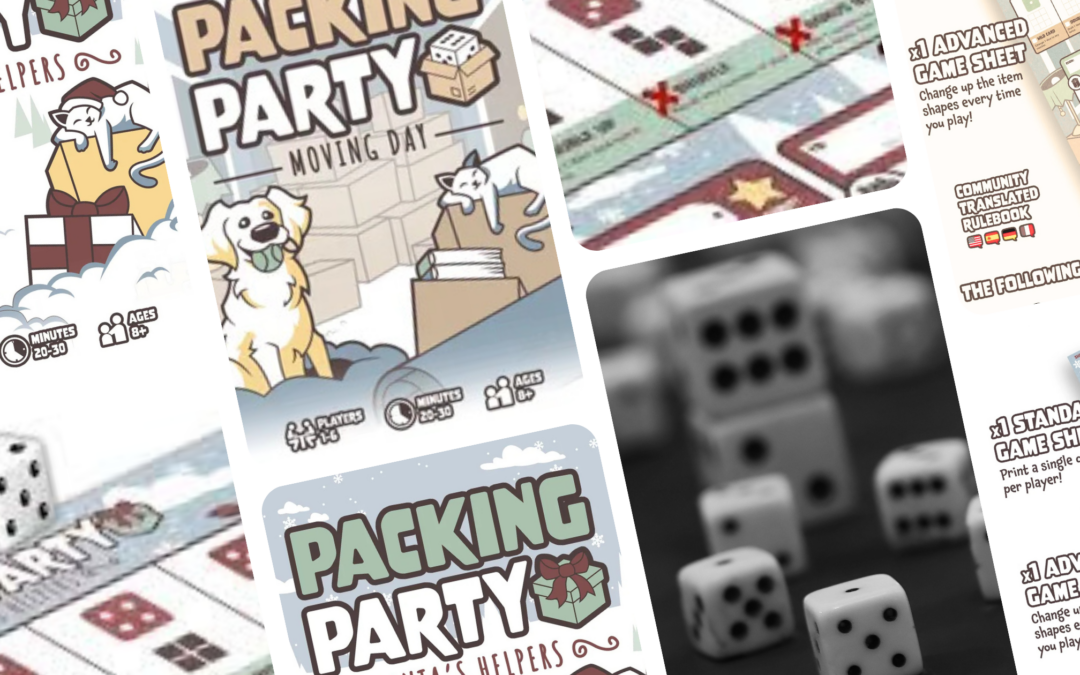
Roll Call: Game Spotlight on Packing Party
Whenever we think of incorporating STEM or STEAM into our schoolwork, it usually comes down to math worksheets or elaborate robotic projects. Not to be forgotten, however, is the importance of puzzles in developing spatial reasoning skills. By puzzles, I don’t mean your standard 500-piece jigsaw puzzle, but a surprising twist with 2-dimensional puzzles. Research shows that strong spatial reasoning skills and the ability to mentally manipulate objects are essential for developing the necessary talents required for engineering, architecture, and artistic fields.
For younger students, this skill serves as the foundation for a future in geometry and mathematical understanding. As for the teens, it can even help with chemistry. And for the adults? It offers a satisfying mental break. It’s the perfect, low-stress puzzle to unwind with at the end of a long day, giving your brain a focused, productive challenge that feels restorative.
That’s the power packed into a fantastic game called Packing Party, which trains the brain to think steps ahead, manipulate objects, make plans, and manage spatial reasoning, all under the disguise of packing Santa’s bag or packing up boxes for a moving day!

Packing Party Mission Briefing: The Essentials
- Genre: Print & Play, Roll & Write, Puzzle, Dice
- Player Count: 1–6 players (Excellent solo option!)
- Recommended Age: 8+
- Play Time: 20–30 minutes
- Theme Versatility: Includes two unique variants: the evergreen “Moving Day” version, making it usable all year long, or the festive “Santa’s Helpers!”
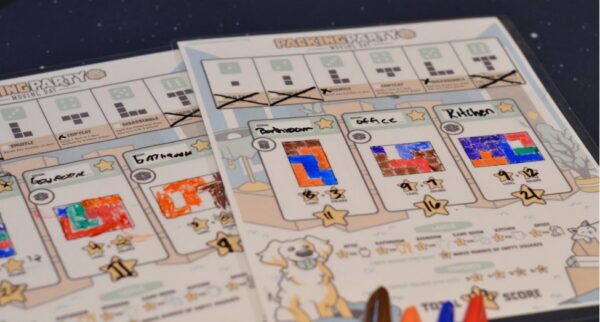
- The Concept: Players draft dice/marker combinations to determine a polyomino (Tetris-style) shape and an item type, which they then draw into their boxes to score points.

How to Play: The Quick Tour
Packing Party is a game of strategic efficiency. At its core, the game is a simple process of visual problem-solving:
- Drafting Items: On your turn, you draft one available item, balancing the specific shape with the item type you need for your scoring goals.
- Packing the Boxes: You draw the shape into one of your three active boxes. You must fit the shape without overlapping any other items, which requires mentally rotating and reflecting the shape before marking your sheet.
- Delivering the Cargo: The ultimate goal is to strategically time the completion and “Delivery” of your boxes to maximize the number of points based on the items you packed.
The Learning Cargo: Skills We Pack
This game is like a sneaky worksheet, without being a traditional worksheet! It indirectly strengthens those cognitive learning skills that tap into the STEAM thinking.
Spatial Reasoning
- Mental Might: Each turn, a player must examine a shape and mentally manipulate it to find the best possible fit in the box. Flip, turn, and rotate, requiring 3D thinking in a 2D space. These are the out-of-the-box thinking skills you want to strengthen in the future for chemistry, geometry, and art.
- Geometry Secrets: Without touching a textbook, players intuitively apply geometric principles, such as area measurement and congruency.
- Visual Balance: This trains their eye for visual balance and composition, a crucial skill from art to building.
Executive Function and Planning
- Project Planning: They aren’t just filling one box; they’re managing three simultaneous projects! This multitasking helps train the brain to see the big picture and plan several moves ahead.
- Think Like a Pro: Every decision is about optimization. Is it worth taking the small piece now to save that perfect, huge space for later? They are constantly calculating value vs. risk.
- Real-World Logic: The game consistently forces your student to make the best choice out of the available options on the board. Sometimes the move is painful, but you have to keep moving forward! Is the perfect option always available? Certainly not! Is that real life? Certainly is! That is problem-solving at its finest.
Probability and Risk
- May the Odds Be Ever in Your Favor: Since the shapes are determined by dice, your students are subtly practicing probability and calculated risk-taking. Should I risk waiting for that perfect shape? What are the chances I’ll roll for the shape I need? What are the chances someone will grab that die before I get to it?
- PIVOT: When the dice don’t deliver the shape they wanted, the game forces them to pivot, adjust the plan, and find a new solution. Adaptability is the most essential skill for an adventurer!
Navigating the Game: Customizing the Learning Voyage
This game is incredibly versatile! With a few simple adjustments, you can easily turn Packing Party into an exciting warm-up exercise for an 8-year-old or a strategic planning challenge for a high schooler (and yourself)!
For Your Junior Navigators (Ages 6-9)
- Focus on the Fit: Worried about cognitive overload? For the first few plays, remove the complex scoring. Challenge them to completely fill one box, focusing solely on the spatial puzzle of rotating and fitting the shapes.
- Area & Arithmetic: Use the game for simple arithmetic and counting. Before and after placing a shape, have the child count the total number of squares filled in their box. This is simple addition practice that subtly reinforces the concept of area.
- Buddy System: Play cooperatively! Have two younger students work together on a single sheet, discussing each shape’s rotation and placement decisions out loud. This forces them to verbalize their spatial reasoning.
For Your Senior Explorers (Teens and Up)
- The Constraint Challenge: Utilize the Advanced Game Sheets. At the start of the game, a dice roll determines which six specific shapes are available for everyone. This pre-game randomization forces older students to immediately analyze a new set of shapes and constraints, promoting advanced strategic adaptability.
- Justify Every Move: Before marking a shape on the sheet, challenge the player to state their reason for the placement: “I’m putting the large L-shape here because it saves the two corner squares for a future 1×1 block.” This pushes them from intuitive play to executive function analysis.
- Themed Report: Use the Moving Day variant. Once the game is over, challenge your teen to write a short “Packing Memo” explaining their packing strategy. Which boxes were the easiest? Which room needed the most planning? (Great for integrating writing).
Print-and-Play Bonus Tip
- Laminate for Longevity: Since this is a Print & Play, consider laminating the game sheets and using dry-erase or wet-erase markers. This turns a one-time activity into an endless resource for lessons and family downtime! Fewer scattered papers and ready on a moment’s notice! (I found mine here)
- Colored Dice: I happen to have a box of colorful dice, and if you’re looking to help a younger one learn and match colors, these are perfect to swap out your standard white & black dice! Or, if you just like a nice pop of color on the table. (Colorful dice in the photos found here)
Beyond Academics: Why Your Family Will Love It
What’s the best part about Packing Party? You can—and should—just get it out for fun any time! While it’s a stealthy skill-builder, its primary mission is to bring your family together for quality time and relaxed competition.
- Low-Stress, High-Fun: Unlike highly competitive strategy games, Packing Party is a light, focused puzzle. It’s perfect for unwinding after a long school day, offering quiet concentration. (Something I’m sure many of us can appreciate!)
- A Game for All Seasons: Moving Day and Santa’s Helpers lets you switch themes, keeping the game feeling fresh and relevant, so it stays on your table longer than a single holiday season.
- The Power of Print & Play: Print & Plays to the rescue! It’s a portable, low-cost activity that can be tucked into a backpack during a coffee shop visit, keeping someone preoccupied while waiting between extracurricular activities, or used as a laminated version for endless use on vacations.
- Solo Satisfaction: The robust single-player option means your student can still get valuable practice and have fun, even if everyone else is busy! It’s perfect for independent learning time or keeping fast finishers engaged.
Ready to Roll? Your Next Steps
Packing Party is a perfect example of how games can transform learning from a chore to joy. It shows that a great educational resource doesn’t need to be expensive or complicated—it just needs to be fun! Go ahead and give this game a try; I can guarantee you’ll be surprised by how much skill-building is packed into those simple boxes!
You can find Packing Party from Shiny Pigeon Games here!
Since Packing Party is all about efficiency, what is the hardest real-life item (or space!) you have ever tried to pack or organize efficiently? Want to share your organization- or weird-item-moving stories! Join other homeschooling parents and me in the Homeschool Connections Facebook Group or in the HSC Community to continue the conversation.
This article originally appeared on Navigator Lana.
This article contains affiliate links.